
No-KYC Crypto Casinos: Real Thresholds, Not Myths (2026)
Which crypto casinos actually let you play without documents, where the verification thresholds really sit (mBit above 1 BTC, Winz.io around €2,000, Oshi on risk flags only), what triggers a check anyway, and what no-KYC can never mean.
11 min read · published 2026-10-30
Search for no-KYC casinos and you will find two kinds of pages: affiliate sites promising total anonymity, and compliance blogs insisting the concept doesn't exist. Both are wrong in opposite directions. No-KYC-by-default operation is real — two of the six brands the bureau audits run it — but it is a threshold model, not a promise: every operator reserves the right to verify you, and the entire question is where the trigger lines actually sit. Those lines are published in terms and conditions, they differ by an order of magnitude between brands, and they are the difference between never uploading a document and hitting a seventy-two-hour hold on the exact day you want a payout. This article documents the real thresholds in our test set, what trips verification anyway, and the three claims in no-KYC marketing that are simply false. For the full picture of how crypto casinos handle money and identity, start from the complete crypto casino guide.
IN THIS ARTICLE
SECTION 01
The three honest tiers of KYC at crypto casinos
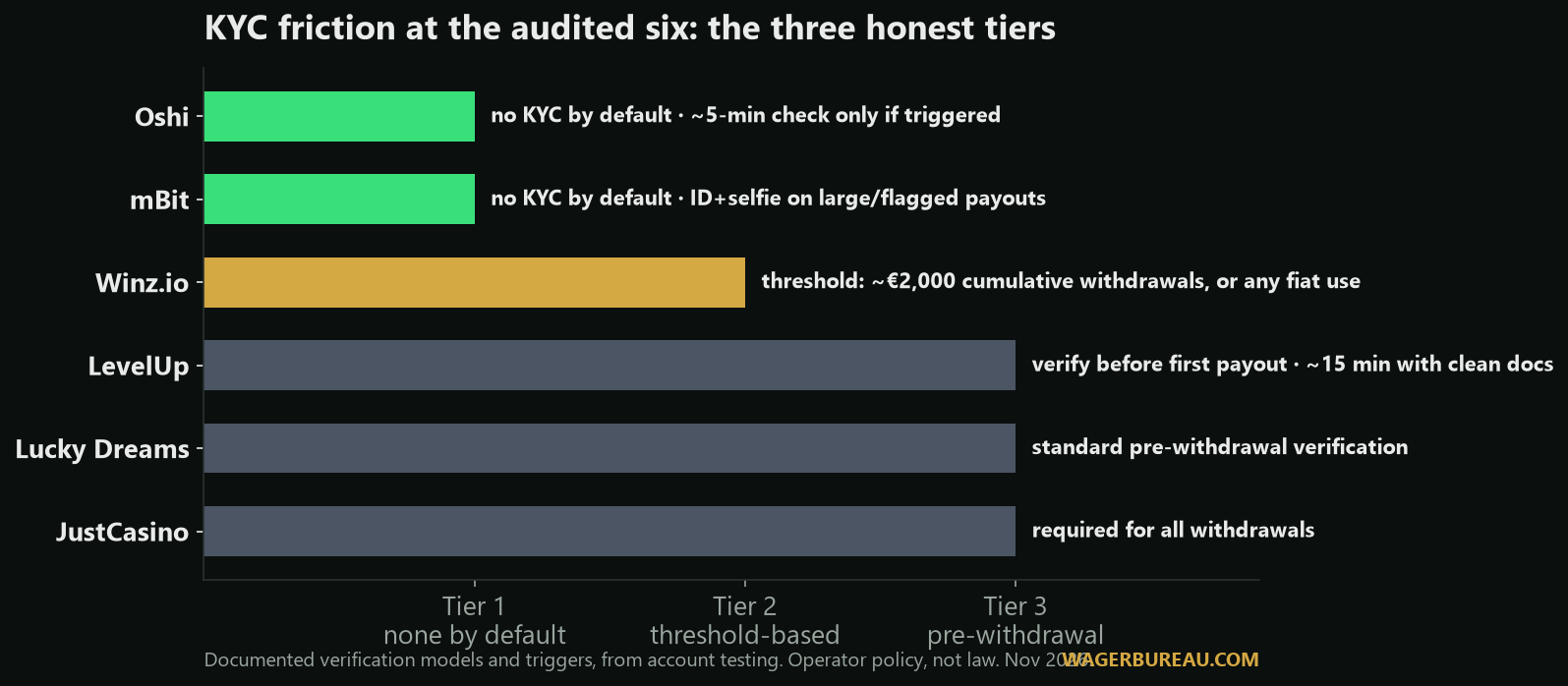
Every crypto-friendly operator we audit falls into one of three verification models, and naming the model is more useful than the no-KYC label. Tier one, no-KYC by default: registration is an email address, deposits and withdrawals in crypto run without any document request, and verification exists only as an exception process for flagged activity or large amounts. Tier two, threshold KYC: play starts document-free, but a defined cumulative-withdrawal line — not a vague one — triggers standard verification when crossed. Tier three, KYC before first withdrawal: deposits are instant, but the first cashout waits until a one-time standard verification clears.
In our test set the split is: Oshi and mBit run tier one — mBit states the trigger line explicitly at single payouts above 1 BTC alongside AML flags, while Oshi's own line to players is that accounts are typically not verified at all, with checks reserved for fraud signals and large cashouts. Winz.io runs tier two with verification triggering around €2,000 in cumulative withdrawals, or immediately if you touch the fiat rail — cards, e-wallets and bank transfers always require identity regardless of brand. LevelUp, Lucky Dreams and JustCasino run tier three: ID, proof of address and payment-method proof before the first withdrawal, processed typically within 24 hours.
Note what the tiers imply about volume. A player who deposits fifty dollars in Litecoin and cashes out two hundred will, in practice, never see a document request at tier one or tier two brands. A player moving five figures a month will be verified everywhere eventually — the only question is whether it happens on their schedule or at the worst possible moment. That asymmetry drives the bureau's core recommendation later in this piece.
One structural footnote: the tiers correlate with license stack, not with trustworthiness. Oshi and mBit hold the same class of verifiable licenses — Anjouan plus Tobique for Oshi under Novatrix S.R.L., a direct post-LOK Curaçao GCB license for mBit — as the tier-three brands. How those jurisdictions work, and why most review sites still list the wrong ones after the 2025 restructuring, is covered in our licensing chapter and the dedicated license jurisdictions guide.
| Brand | Model | Documented trigger |
|---|---|---|
| Oshi | No KYC by default | Checks on trigger only; typically a ~5-minute verification when asked |
| mBit | No KYC by default | ID + address + selfie on large or flagged payouts; extra checks for bigger sums |
| Winz.io | Threshold-based | ~2,000 EUR cumulative withdrawals, or any fiat use |
| LevelUp | Pre-withdrawal | Standard verification before first payout, ~15 min with clean documents |
| Lucky Dreams | Pre-withdrawal | Standard verification required before withdrawal |
| JustCasino | Pre-withdrawal | Required for all withdrawals, typically processed quickly |
Operator policy, not law: thresholds change without notice, and AML obligations override every model.
The thresholds, stated plainly
mBit: no default checks; verification above 1 BTC per payout or on AML flags. Oshi: no default checks; fraud signals and large cashouts only. Winz.io: ~€2,000 cumulative withdrawals, or any fiat-rail use. LevelUp, Lucky Dreams, JustCasino: one-time standard verification before the first withdrawal.
SECTION 02
What triggers verification anyway — the five overrides
No-KYC-by-default does not mean no-KYC-ever, and the override triggers are remarkably consistent across the industry. First: cumulative volume. Internal AML thresholds track lifetime deposits and withdrawals, and crossing them queues a verification request even when no single transaction looked large. Second: single large payouts — mBit's published 1 BTC line is the clearest example, and extended verification at that level can include source-of-funds questions, not just an ID photo.
Third: bonus-linked withdrawals. Cashouts that clear a welcome bonus get term-compliance review — max-bet violations, excluded games, one-account-per-household checks — and that review is where many operators attach a document request. If you play bonuses aggressively, expect verification earlier than the headline threshold suggests; if payout speed matters more than bonus value, playing without the bonus is the single most effective accelerator, a trade-off we quantify in the wagering math guide.
Fourth: country and network signals. Every operator geo-blocks its restricted list at registration, but enforcement really happens at withdrawal, when IP history, device fingerprints and payment metadata get reviewed together. A mismatch — an account registered in an accepted country playing consistently from a restricted one — is treated as a terms violation. Fifth: the fiat rail. The moment a card, e-wallet or bank transfer touches the account, full KYC applies everywhere, because the payment processors demand it even where the casino's crypto rail would not.
The pattern behind all five: verification is risk-triggered, and the player controls most of the risk surface. Clean single-country play, crypto-only banking, bonus terms respected, amounts under the stated lines — that profile sails through tier-one and tier-two brands indefinitely. The complaint threads we read for every review are dominated not by random KYC cruelty but by exactly these five triggers firing on accounts that didn't know the lines existed.
The VPN clause is not a technicality
Playing through a VPN from a restricted country is grounds for voided winnings at every brand we track — it is the most common root cause in public payout disputes. No-KYC play does not suspend the restricted-country list; it just delays the moment the list is enforced.
SECTION 03
What no-KYC does not mean
Three claims recur in no-KYC marketing, and all three fail on contact with the actual terms. Claim one: anonymity. Blockchains are permanent public ledgers — your deposit address, the casino's hot wallet and your withdrawal address are all visible forever, and chain-analysis tooling links address clusters routinely. What a no-KYC casino offers is privacy from paperwork on routine amounts, which is a real and legitimate preference; it is not invisibility, and anyone selling it as such is selling something that does not exist.
Claim two: that no-KYC means unlicensed, lawless, or consequence-free. The tier-one brands in our set hold the same verifiable licenses as everyone else, enforce the same restricted-country lists, and apply the same bonus terms. The absence of an upfront document request changes onboarding friction, not the legal reality of where you may play — which remains your responsibility to check, as our responsible gambling resources spell out.
Claim three: that no-KYC protects a player in a dispute. The opposite is closer to true. When a payout dispute escalates to a platform like AskGamblers or Casino.guru, the operator's defense almost always includes account-verification findings — and a player who bypassed a restriction or multi-accounted has no standing, documents or not. The brands with the strongest complaint-resolution records in our set, LevelUp among them with a fully-resolved public complaint file, are not the most anonymous ones; resolution quality and verification model are simply different axes.
The bureau's bottom line: choose the verification model that matches your actual volume, not the marketing. Under the thresholds, Oshi, mBit and Winz.io genuinely deliver document-free play. Above them, verification is inevitable everywhere — so do it proactively, on a calm day, before your first withdrawal: a planned fifteen-minute upload beats an unplanned multi-day hold on a five-figure cashout, every single time. For how payout speed interacts with all of this, continue to the instant-withdrawal breakdown — and for the Canadian regulatory and banking layer on top, the Crypto Casino Canada guide.
Who should pick what
Low-volume, crypto-only, privacy-minded: Oshi or mBit, stay under the lines, never see a form. Mid-volume: Winz.io's €2,000 threshold model, or verify proactively. High-volume or fiat-mixing: the verification is coming anyway — do it up front and optimize for resolution quality and limits instead.
FAQ
Frequently asked
Which crypto casinos are actually no-KYC?+
Can a no-KYC casino still ask for my documents?+
Is playing at a no-KYC casino anonymous?+
Does no-KYC mean the casino is unlicensed?+
What is the fastest way to avoid KYC delays on a big win?+
FOOTNOTE
This article is original editorial published by Wager Bureau on 2026-10-30. Every claim in the article is independently verifiable against the cited sources. We update articles when material facts change and surface the "updated" date at the top of the page. 18+ · gambling can be addictive · please play responsibly. If gambling stops being fun, call GamCare or the NCPG. See the bureau's full responsible gambling page for free 24/7 helplines. Key terms used on this page are defined in the glossary.