
The Complete Guide to Crypto Casinos (2026)
Everything that actually matters about crypto casinos in 2026: how on-chain deposits and withdrawals work, real payout speeds measured in minutes, KYC thresholds brand by brand, the post-2025 licensing migration most review sites still have wrong, and the bonus math behind the headlines.
94 min read · published 2026-10-30 · updated 2026-11-08
A crypto casino is not a fiat casino with a Bitcoin logo bolted on. The banking rail changes the product: deposits confirm in minutes without a card issuer in the loop, withdrawals settle on-chain faster than most banks process an e-transfer, identity checks follow thresholds instead of blanket rules, and an entire category of provably fair games exists that fiat platforms cannot offer. It also changes the risks — license stacks moved wholesale in 2025 and most review sites never updated, clone domains impersonate real brands, and bonus terms carry the same 40x math regardless of what currency you deposit. This guide is the bureau's complete reference on the subject. Everything in it comes from our own audit pipeline across six operators we track continuously — licenses verified at the regulator's registry, payout windows timed on real withdrawals, KYC thresholds documented from operator terms and tested accounts — and every section links to the deeper breakdown where we show the work.
IN THIS ARTICLE
- 01.What a crypto casino actually is
- 02.How money moves: deposits, confirmations, balances
- 03.Payout speed, measured — not advertised
- 04.KYC and anonymity: thresholds, not myths
- 05.Licensing in 2026: the migration nobody updated
- 06.Bonuses and the wagering math behind the headlines
- 07.The coins: what to deposit and why it matters
- 08.The games: slots, live tables, and provably fair originals
- 09.Playing from Canada: the real picture
- 10.Bankroll, volatility and the responsible-play layer
- 11.Security and wallet hygiene for casino players
- 12.The 2026 trend map: where the segment is moving
- 13.How we choose: the five-pillar audit, applied
- 14.Verdicts: the right casino by player profile
SECTION 01
What a crypto casino actually is
A crypto casino is an online casino where the cashier runs on cryptocurrency rails: you deposit Bitcoin, Ethereum, a stablecoin like USDT, or another supported coin, your balance is held either in crypto or in a fiat equivalent, and withdrawals are paid back to your wallet address on-chain. The games themselves are mostly the same licensed titles you find at fiat casinos — slots from Pragmatic Play, NetEnt or Hacksaw Gaming, live tables from Evolution — plus a crypto-native category of provably fair originals (dice, crash, plinko, mines) that exists only on this side of the industry.
The practical distinction that matters is the banking loop. A fiat casino deposit routes through a card network or bank processor that can decline gambling transactions, charge fees, or hold funds in dispute. A crypto deposit is a blockchain transaction: once the network confirms it, the operator credits it, and nobody in between has an opinion about it. The same logic applies on the way out, which is why the fastest crypto casinos settle withdrawals in 10 to 15 minutes while fiat operators quote days — a difference we measure continuously and document in our payout speed breakdown.
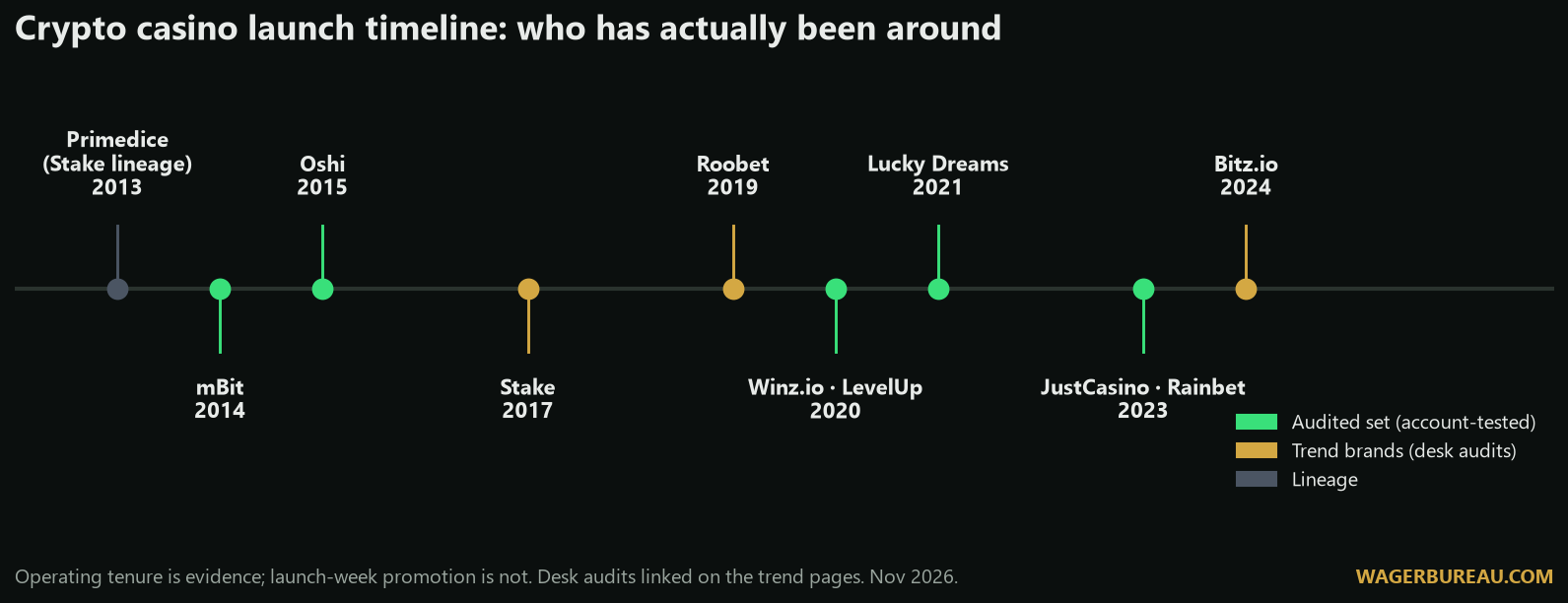
Within the category there are two architectures worth distinguishing. Crypto-only operators — mBit Casino is the cleanest example, running Bitcoin-native since 2014 — bank exclusively in crypto, with no card rail at all. Hybrid operators — Winz.io, Oshi, LevelUp, Lucky Dreams and JustCasino — run crypto and fiat cashiers side by side, so you can deposit USDT today and a Visa payment tomorrow from the same account. Hybrids suit players who want optionality; crypto-only operators tend to have the leanest banking friction because the entire compliance stack is built for one rail.
What a crypto casino is not: unregulated by definition. Every operator in our test set holds a verifiable license — the jurisdictions changed substantially in 2025, which we cover in the licensing chapter below — and the serious ones publish license numbers you can check in a regulator registry. The 'crypto equals lawless' framing is mostly a holdover from the industry's 2014-2018 era. The real compliance differences today are about KYC thresholds and restricted-country enforcement, both of which we document per brand rather than generalize.
One more structural fact worth internalizing before you deposit anywhere: cryptocurrency price risk sits on top of gambling risk. If you deposit 0.01 BTC, play even, and withdraw 0.01 BTC a week later, your fiat-denominated balance moved with the Bitcoin price the whole time. Stablecoins — USDT and USDC are supported at every brand we track — remove that second layer of variance, which is why our guides treat 'deposit in stablecoins unless you are deliberately holding the coin anyway' as the default recommendation for players who think in fiat terms.
The one-sentence version
Same licensed games, different banking rail: on-chain deposits and withdrawals cut out the card network, which is where crypto casinos win on speed, fees and friction — and the license, bonus and KYC fine print is where they still have to be audited like any other operator.
SECTION 02
How money moves: deposits, confirmations, balances
A crypto deposit has three steps. First, the casino cashier generates a deposit address for your chosen coin and network — a BTC address on the Bitcoin network, or a USDT address on Tron (TRC-20) or Ethereum (ERC-20). Second, you send funds from your own wallet or exchange account to that address. Third, the operator credits your casino balance after a defined number of network confirmations — typically one confirmation for Bitcoin, which lands in roughly ten minutes, and near-instant crediting for fast chains like Tron, Solana or Litecoin. The full mechanics, including every network's typical confirmation window, are in our deposits and withdrawals guide.
The two mistakes that actually lose money at this step are both network-selection errors. Sending USDT on the wrong network — depositing ERC-20 tokens to a TRC-20 address or vice versa — can strand funds in a way that support may or may not be able to recover, and recovery, where possible, takes days. And sending from an exchange that batches withdrawals can add an hour of delay the casino has no control over. Neither mistake is specific to any operator; both are permanent features of self-custodied money. Copy addresses exactly, match the network label in both interfaces, and send a small test amount the first time you use a new coin or brand.
Minimum deposits on the crypto rail are low by industry standards. Across our test set the effective floors run from about one dollar equivalent at LevelUp to the twenty-to-thirty dollar range at brands whose welcome bonuses require a qualifying deposit — mBit's bonus tiers activate at roughly 30 USDT, Winz.io's wheel spins at $25. Deposit fees on the operator side are zero at every brand we track; the only cost is the blockchain network fee, which you pay to the network, not the casino, and which stablecoins on Tron keep under a dollar.
Balance handling differs by operator and it affects your price exposure. Some cashiers hold your balance in the coin you deposited — you wager in BTC, win in BTC, and carry Bitcoin price risk for the whole session. Others convert on arrival to a fiat-denominated balance (USD or EUR) and convert back on withdrawal. Both models are legitimate; the difference matters if the market moves while you play. The cashier page states which model applies before you deposit, and our per-brand reviews note it in the payments section.
On the way out, the withdrawal pipeline is: you request a cashout to your wallet address, the operator's processing layer reviews it (this is where the real time variance lives — minutes at the best brands, up to 24 hours of stated 'pending' window at others), and the payment then settles on-chain in one block time. Operators in our set absorb the network fee on most withdrawals or pass through a small flat amount; none charge percentage fees on the crypto rail. The measured numbers, brand by brand, are the subject of the next chapter.
The network-mismatch rule
The coin and the network are separate choices. USDT exists on Tron, Ethereum, Solana and more — the casino's deposit address is for one specific network, and tokens sent on any other network do not arrive. Match the network label character for character, every time, on both sides.
SECTION 03
Payout speed, measured — not advertised
Every casino advertises fast withdrawals; almost none publish numbers. The bureau times real withdrawal windows — from cashout request to on-chain settlement — and re-tests after every platform migration, because processing behavior changes when operators change license or payment stack. This is the single area where crypto casinos most clearly beat the fiat industry, and also the area with the widest spread inside the category itself.
The measured picture across our test set as of this writing: mBit Casino settles typical crypto withdrawals in about ten minutes, with our test cashouts landing under fifteen. Winz.io averages around twelve minutes on the crypto rail. Oshi posted a fourteen-minute median across thirty withdrawals in a third-party audit in mid-2026, with verified-account repeat withdrawals clearing in the thirty-to-sixty-minute band. LevelUp, Lucky Dreams and JustCasino run zero-to-one-hour crypto windows after approval, with Just and Lucky Dreams carrying a stated pending window of up to 24 hours that in practice clears much faster on clean accounts.
What separates a ten-minute operator from a three-day one is almost never the blockchain — settlement is one block time everywhere. It is the processing layer: whether withdrawals are auto-approved under a threshold, whether a human reviews bonus-linked cashouts, whether KYC is demanded at withdrawal time rather than earlier, and whether the operator batches payments on a schedule. That is why our reviews document the conditions attached to the headline number: account verified or not, bonus active or not, amount relative to the operator's caps.
Withdrawal limits are the other half of payout reality, because a fast operator with a low cap pays a big win slowly in aggregate. The spread in our set is wide: mBit caps at 3 BTC per week and 10 BTC per month with wins above 10 BTC paid in monthly installments; Winz.io runs approximately $100,000 weekly and $400,000 monthly equivalents with effectively uncapped crypto rails for routine amounts; Oshi, Lucky Dreams and JustCasino operate in the €4,000 daily / €8,000 weekly / €30,000 monthly band typical of their license class; LevelUp sits lower at roughly €3,000 daily and €15,000 monthly at base tier, rising substantially with VIP level. If you play at stakes where these caps bind, the caps — not the minutes — are your real payout speed.
The practical checklist for getting paid fast, which we expand with full per-brand data in the instant-withdrawal breakdown: complete verification before your first withdrawal wherever the brand requires it at all; withdraw without an active bonus attached, because bonus-term review is the most common manual-hold trigger; stay under the auto-approval thresholds where we document them; and use a fast network — Litecoin, Tron or Solana — if the ten-minute difference between chains matters to you.
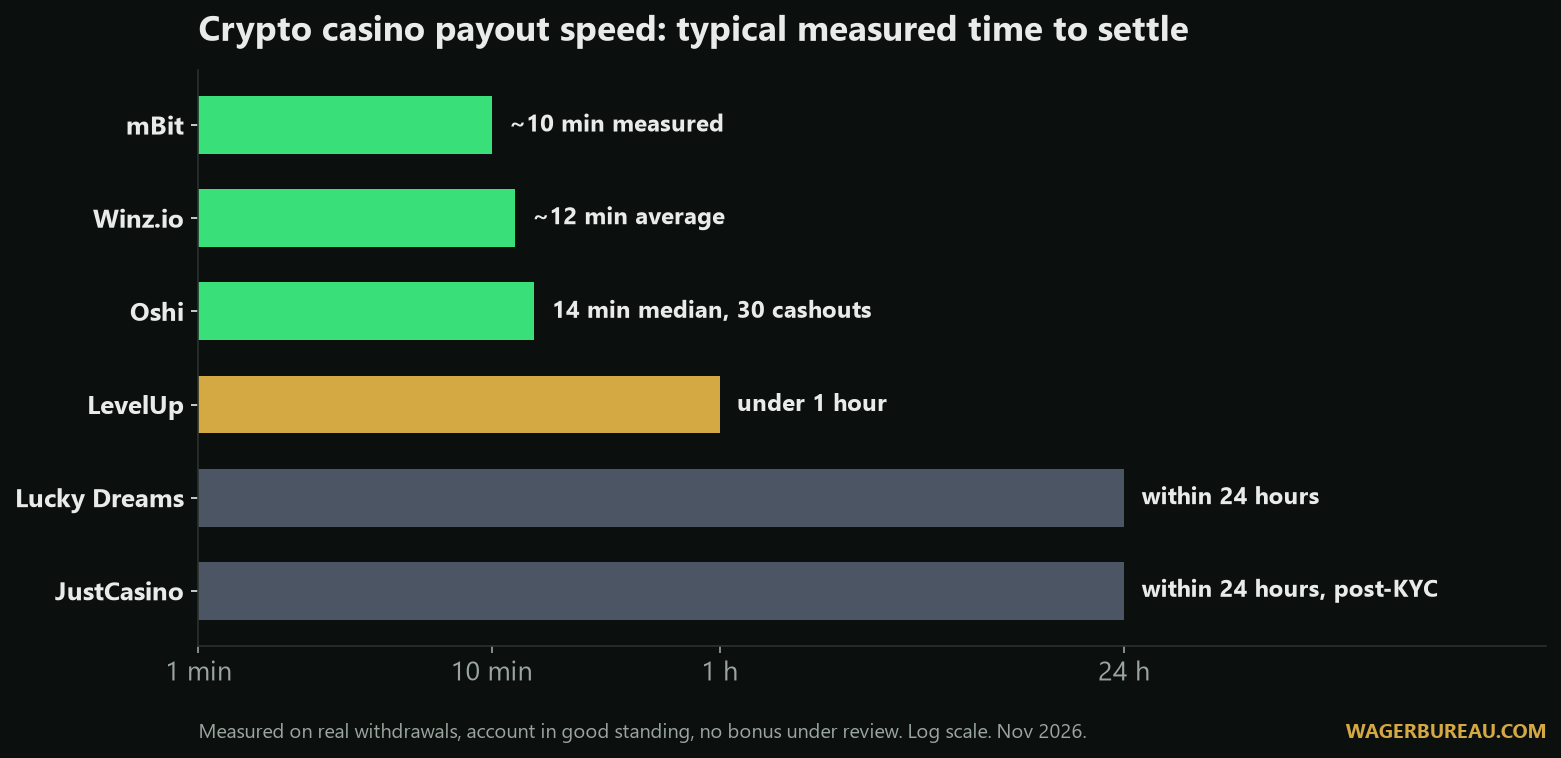
| Brand | Measured (typical) | Official window |
|---|---|---|
| mBit | ~10 minutes | 0-24h stated |
| Winz.io | ~12 minutes | Avg 12 min stated |
| Oshi | 14 min median (30 cashouts) | Under 3h typical |
| LevelUp | Under 1 hour | 0-1h crypto/e-wallet |
| Lucky Dreams | Within 24h | 0-24h crypto |
| JustCasino | Within 24h post-KYC | 24h stated |
Add chain time on top: ~10 min first BTC confirmation, ~2.5 min LTC, ~1 min DOGE, seconds on TRC-20.
Measured, not promised
Best measured crypto payout windows in our set: mBit ~10 minutes typical, Winz.io ~12 minutes average, Oshi ~14 minutes median (30-withdrawal audit). The spread inside the category is wider than the spread between categories — which is exactly why we publish numbers instead of adjectives.
SECTION 04
KYC and anonymity: thresholds, not myths
No topic in crypto gambling is marketed harder or explained worse than KYC. The honest version is that 'no-KYC casino' almost never means an operator that will never ask who you are; it means an operator that does not demand documents up front and only triggers verification at defined thresholds or risk flags. Those thresholds differ enormously between brands, they are published in terms and conditions almost nobody reads, and they are the difference between a smooth cashout and a seventy-two-hour document loop at exactly the moment you want your money.
Our test set splits into three honest tiers. No-KYC-by-default: Oshi and mBit let you register with an email, deposit crypto, play and withdraw without any document check on routine activity — verification triggers only on AML risk flags or large cashouts, with mBit's stated line at payouts above 1 BTC and Oshi's at unusual patterns or large cumulative amounts. Threshold-KYC: Winz.io runs email-only signup with verification triggering around €2,000 of cumulative withdrawals, or immediately on any fiat-rail use. KYC-before-first-withdrawal: LevelUp, Lucky Dreams and JustCasino require standard ID, address and payment-method verification before the first cashout — the classic flow, done once, typically processed inside a day.
What triggers checks even at no-KYC-by-default brands is consistent across the industry: cumulative withdrawal volume crossing an internal threshold, deposits or play patterns that trip AML monitoring, bonus-linked cashouts under term review, any use of the fiat rail, and mismatches between account country and network signals. That last one matters more than players expect — VPN use from a restricted country is grounds for confiscated winnings at every single brand we track, and it is the most common root cause in the public complaint threads we read for every review. The full document flow, processing times and escalation paths are in our KYC verification guide.
What no-KYC does not mean: it does not mean license-free — Oshi and mBit hold the same class of verifiable licenses as the KYC-first brands; it does not mean restricted countries are suddenly available — the restriction clauses apply regardless of whether documents were collected; and it does not mean anonymity from the blockchain itself, where every transaction is permanently public. The accurate frame is privacy from paperwork on routine amounts, not invisibility.
Our guidance, which we defend in detail in the no-KYC breakdown: if you value document-free play, pick a brand whose threshold model matches your volume — under the thresholds at Oshi, mBit or Winz you will likely never upload anything. If you play larger amounts, do the opposite: verify proactively before your first withdrawal wherever you play, because a planned fifteen-minute KYC beats an unplanned three-day hold on a five-figure cashout every time.
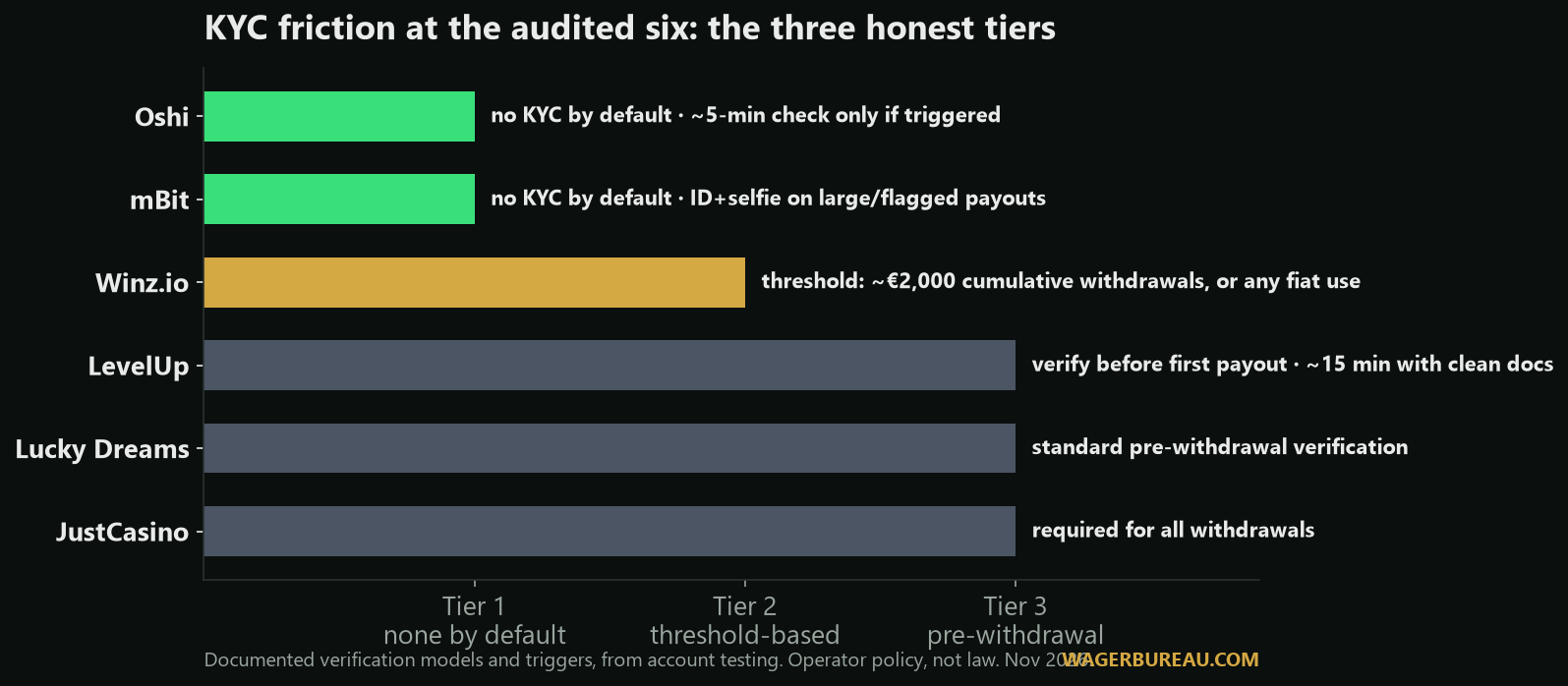
The three tiers at a glance
No-KYC by default: Oshi, mBit (checks only on large payouts or AML flags — mBit's stated line is 1 BTC). Threshold: Winz.io (~€2,000 cumulative withdrawals, or any fiat use). KYC before first withdrawal: LevelUp, Lucky Dreams, JustCasino. VPN play from a restricted country voids winnings everywhere.
SECTION 05
Licensing in 2026: the migration nobody updated
If you read license information on most casino review sites today, you are probably reading history. Through 2025 the industry's dominant white-label structure — dozens of brands operating as Dama N.V. under Curaçao's old master-license system — was dismantled and reorganized. Brands moved to new operating entities and new jurisdictions, license numbers changed, and the majority of affiliate sites simply never re-verified. We re-check every license in our set against the issuing regulator's own registry on a recurring schedule, and the current picture below is the verified state, not the cached one.
The Novatrix group: Oshi, Winz.io and LevelUp now operate under Novatrix S.R.L., with license coverage from Anjouan (Comoros) and the Tobique Gaming Commission in New Brunswick, Canada — Winz adds an Estonian registration to the stack. The Curaçao GCB direct licenses: mBit operates under Scores55 Tech B.V. with Curaçao Gaming Control Board license OGL/2024/1307/0748 issued under the post-LOK framework, and JustCasino and Lucky Dreams share Just Entertainment B.V.'s GCB license OGL/2024/164/0246 — both verifiable in the GCB's public portal. Where a review site still lists Dama N.V. or an 8048/JAZ sub-license for any of these brands, that data predates the migration.
What these jurisdictions actually mean for a player, honestly stated: none of them are tier-one regulators in the MGA or UKGC sense. Curaçao's post-2024 GCB framework is a genuine upgrade on the old master-license era — individual accountability, a public register, a complaints channel — and Anjouan and Tobique are functional offshore frameworks whose practical player protection runs primarily through dispute platforms like AskGamblers and Casino.guru rather than through the regulator's own enforcement. Our safety assessment therefore weighs license status as one pillar among five, alongside the operator's complaint-resolution record, which varies more between brands than the license class does. How to read every jurisdiction, and how to verify a license number yourself in two minutes, is covered in our licensing guide.
The verification habit we recommend: find the license number in the casino's footer, then confirm it at the regulator's registry — cert.cga.cw for Curaçao GCB licenses — checking that the operator entity, the domain and the status all match. Two minutes of checking filters out the single biggest hazard in the niche: clone sites. Our keyword monitoring surfaces entire networks of look-alike domains impersonating real casino brands to harvest deposits; a clone can copy a homepage perfectly, but it cannot make the regulator's registry list its domain.
License changes are also why dates matter on reviews. An operator that migrated jurisdictions in 2025 may have changed payment processors, bonus terms and KYC behavior in the same move — treat any undated casino review, ours included if we ever shipped one, as unverified. Every review on this site carries its last-verified date, and the licensing table above is re-checked monthly as part of the bureau's methodology.
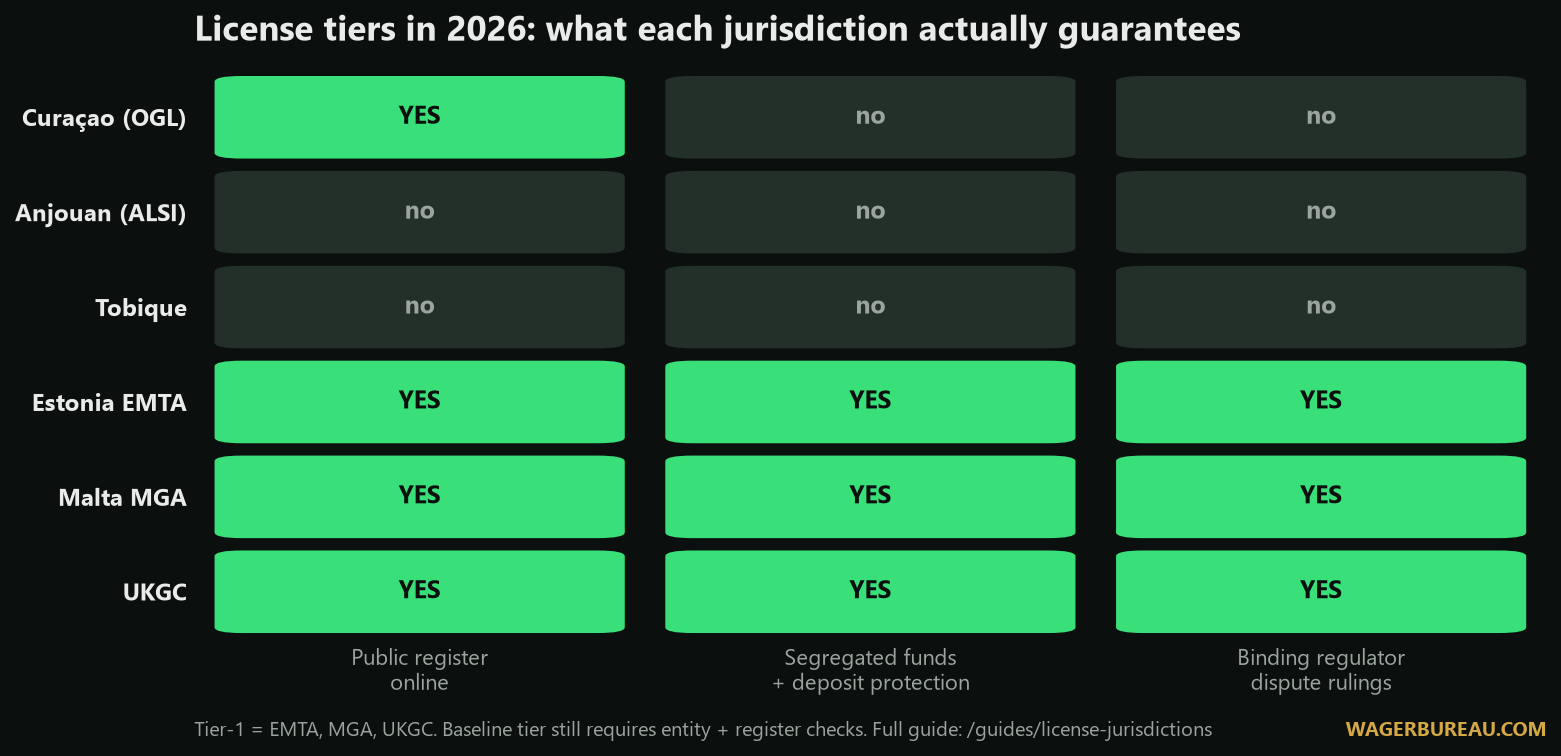
Stale-data hazard
The 2025 restructuring moved most of this segment off Dama N.V. and the old Curaçao 8048/JAZ master licenses. Reviews still citing those are running on cached data — and if a site has the license wrong, treat its payout and bonus data as equally unverified.
SECTION 06
Bonuses and the wagering math behind the headlines
Crypto changes the banking rail; it does not change bonus mathematics. The segment standard across our set is a welcome package with 40x wagering on bonus funds, a $5 max bet while wagering is active, slots-only contribution, and a 7-to-14-day validity window. Run those parameters through the arithmetic and the realistic cleared-out value of a headline bonus lands at a fraction of its face amount — our wagering math guide walks the full calculation, and the short version is that a $1,000 bonus at 40x demands $40,000 of slot turnover before anything derived from it can be withdrawn.
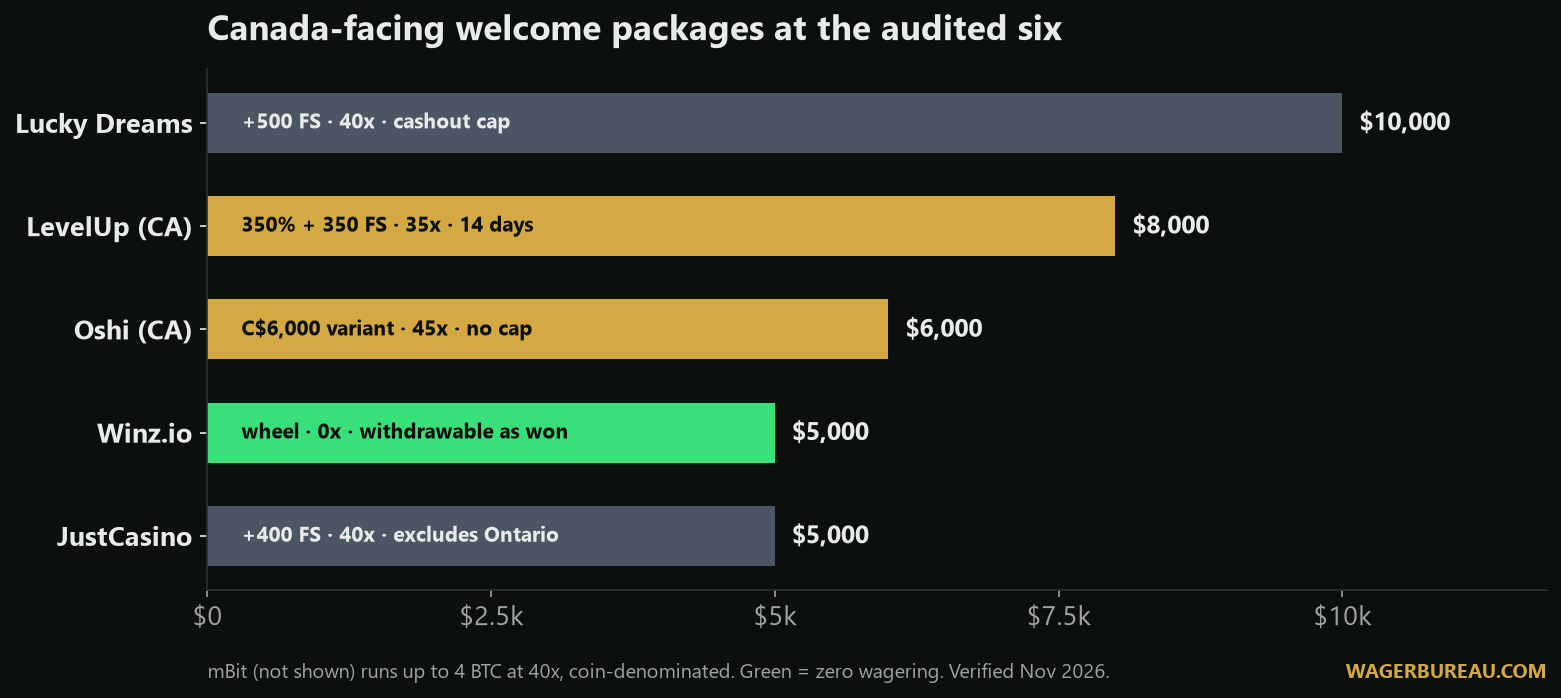
The current welcome structures across the set, verified on our last monthly pass: Winz.io runs a wheel-spin welcome paying up to $5,000, 0.1 BTC or 800 free spins with zero wagering — the structural exception in the entire segment, because wheel prizes are withdrawable as-is. Oshi runs 100% up to 1,111 EUR plus 150 free spins standard at 45x, with regional variants reaching $4,000 or C$6,000, and no max-cashout cap on welcome winnings, a genuinely unusual player-favorable clause. mBit stacks up to 4 BTC plus 325 free spins across three deposits at 40x slots-only, with the VIPBIT code boosting the match to 375%.
LevelUp runs a four-deposit ladder up to $8,000 with 350 free spins and sports freebets in its Canadian-market variant — bonus structures there are heavily geo-split, so the cashier's offer is the binding one. Lucky Dreams carries one of the largest headlines in the set at up to $10,000 plus 500 free spins across five deposits, and JustCasino mirrors the structure at up to $5,000 plus 400 free spins. All three run segment-standard 40x wagering with seven-day validity per stage — generous ceilings, standard math underneath.
How to actually decide: if you want maximum withdrawable value per deposited dollar, a 0x structure beats every 40x headline several times its size, which is why the wheel model scores so well in our bonus-economics pillar. If you want playtime volume rather than cleared cash, the big multi-deposit ladders deliver it. And if payout speed is your priority, remember the interaction documented in the instant-withdrawal breakdown: bonus-linked cashouts get term review, so the fastest withdrawal is one with no bonus attached at all. The current state of every offer lives on the bonuses page, re-verified monthly.
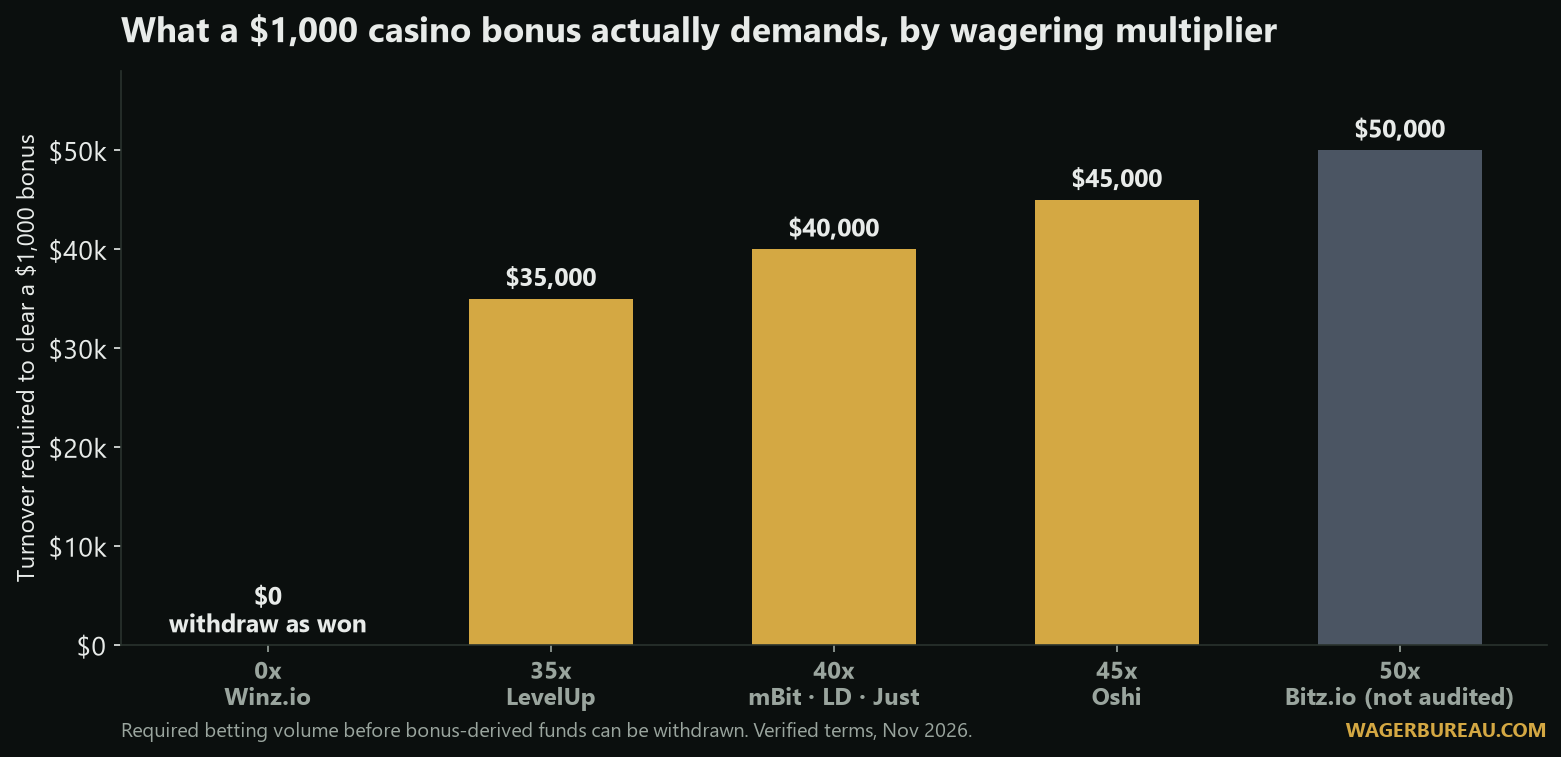
The only number that matters
Cleared-out expected value, not headline size. At 40x slots-only wagering with a $5 max bet, expect to clear 20-30% of a bonus's face value in realistic play; at 0x, the face value is the value. A $500 wager-free prize beats a $5,000 bonus at 40x for most players.
SECTION 07
The coins: what to deposit and why it matters
Coin support across our set is broad and converging: all six brands take Bitcoin, Ethereum, Litecoin, Tether and Dogecoin; most add XRP, Cardano, Tron and BNB; USDC coverage is near-universal, and Winz.io added Solana in 2026. The practical question is not what a casino accepts but what you should send, and that decision has three axes: price variance, network speed, and network fees.
On variance, the bureau's standing recommendation stands: deposit in stablecoins — USDT or USDC — unless you are deliberately holding the coin anyway. A session bankrolled in BTC carries Bitcoin's price movement on top of game variance, in both directions; a stablecoin bankroll isolates the gambling result from the market. Operators that hold balances in fiat-equivalent after conversion partially solve this for you; the cashier page states which model applies, and our reviews note it per brand.
On speed and fees, the network you choose dwarfs the coin you choose. Tron-network USDT settles in seconds at fees of cents; the same USDT on Ethereum mainnet can cost dollars and take minutes at congested hours. Litecoin confirms in roughly two and a half minutes against Bitcoin's ten, which is most of the difference between a twelve-minute and a twenty-minute total withdrawal at a fast brand. The full network-by-network comparison, including the mismatch hazard that strands funds, is in the deposits and withdrawals guide.
One planning note for bonus hunters: minimum qualifying deposits are denominated in fiat equivalents — $20 to $30 across most of the set — so a coin's price at deposit time determines whether your transfer crosses the bonus threshold. Send a margin above the minimum when depositing volatile coins, or use a stablecoin and remove the guesswork entirely.
| Coin | Best for | Watch out for | Deep dive |
|---|---|---|---|
| Bitcoin (BTC) | BTC-denominated bonuses, deliberate holders | Fee floor on small moves; ~10-min blocks | Bitcoin Canada guide |
| USDT (TRC-20) | Fiat-stable bankrolls, bonus clearing | Always match the network on withdrawals | USDT casinos |
| Litecoin (LTC) | Small and frequent moves | Volatile unit between sessions | Litecoin casinos |
| Ethereum (ETH) | Mid-to-large transfers you already hold | Gas pricing; cashiers are mainnet-only | Ethereum casinos |
| Dogecoin (DOGE) | Fast cheap transit, ~1-min blocks | Highest volatility in the core | Dogecoin casinos |
All five are accepted at every brand in the audited set; the rail choice never has to drive the brand choice.
Default choice, stated once
USDT or USDC on a fast cheap network (Tron, or Solana where supported) is the rational default: no price variance during play, second-level settlement, negligible fees. Deposit BTC or altcoins only when holding them is the point.
SECTION 08
The games: slots, live tables, and provably fair originals
Game libraries at crypto casinos are licensed-studio catalogs plus a crypto-native layer, and the catalogs in our set are deep: Lucky Dreams is the volume leader at 14,000-plus titles from more than 137 providers, JustCasino carries roughly 9,500 from 80-plus, mBit around 8,800, Winz.io about 6,700, LevelUp around 6,000 from roughly 100 studios, and Oshi over 5,000 from 125-plus providers. Who actually makes those games, and why provider depth predicts catalog quality, is the subject of our game providers breakdown.
Slots dominate every catalog, and one transparency feature is worth singling out: mBit displays the RTP on every slot tile in the lobby — a small interface decision that saves the terms-digging most operators require. What RTP, variance and house edge actually mean for your bankroll is covered in the math guide; the one-line version is that RTP is a long-run average, variance is what your session actually feels like, and no bonus or strategy changes either.
Live dealer floors run on the same two studios everywhere — Evolution and Pragmatic Play Live — with Ezugi and smaller studios filling regional tables. Expect the standard spread: Lightning and classic roulette, blackjack at every limit band, baccarat, and the game-show titles. The mechanics of latency, dealer staffing and table limits are in the live dealer guide. One bonus-related caution repeated from the wagering chapter: live tables typically contribute 0-10% to wagering requirements, and playing them with an active slots-only bonus can void it outright at some brands.
The crypto-native layer — dice, crash, plinko, mines and the other originals — is where provably fair verification lives. The mechanism is cryptographic rather than institutional: the operator commits to a hashed server seed before the round, your client seed enters the result computation, and the revealed seed afterwards lets you verify the outcome was never altered. That is a stronger per-round guarantee than RNG lab certification, which audits the generator rather than the round. Our test set supports verification on originals across the board, with mBit's sixteen in-house titles and Oshi's Bitcoin-exclusive games the deepest native catalogs.
SECTION 09
Playing from Canada: the real picture
Canada is the bureau's reference market — every brand in our set accepts Canadian players, the payment rails are mature on both the crypto and Interac sides, and the bonus structures include some of the strongest regional variants in the segment: LevelUp's Canadian four-deposit package with sports freebets, Oshi's C$6,000 welcome variant, Lucky Dreams' CA-facing $10,000 package. The complete Canadian playbook — province rules, payment comparison, brand-by-brand verdicts — lives in our Crypto Casino Canada guide, with the payout-speed angle broken out separately in the Canadian instant-withdrawal guide.
The regulatory picture in one honest paragraph: gambling in Canada is regulated provincially. Playing at offshore-licensed sites is, as a general matter, not an offense for the individual player in most provinces — the licensing obligations sit on operators — but Ontario changed the game in 2022 by launching its own iGaming Ontario regime, and operators without an iGO license face restrictions on serving Ontario players. Enforcement differs by brand: JustCasino excludes Ontario explicitly while accepting the rest of Canada. None of this is legal advice; province rules evolve, and checking your own province's current position is on you.
On payments, Canadian players effectively choose between two rails. Interac — supported at the hybrid brands — is familiar and fiat-denominated, but it drags full KYC from the first transaction and settles withdrawals in hours to days. The crypto rail reverses both: the thresholds documented in our KYC chapter apply, and settlement runs in minutes at the fast brands. For players who want speed without holding volatile coins, the stablecoin route from the coins chapter above is the standard answer.
Two Canadian footnotes worth knowing. Quebec and francophone players are a market the operators actively serve — French-language support exists at Oshi, Lucky Dreams and JustCasino among others — and the bureau plans French-market coverage as the content expands. And on taxes: recreational gambling winnings are generally not taxable income for Canadian players under long-standing CRA practice, with the professional-gambler exception; that is a general statement, not tax advice, and edge cases belong with an accountant.
The Ontario asterisk
Ontario runs its own iGO licensing regime, and offshore brands handle it differently — JustCasino excludes Ontario outright; others serve it at their own risk posture. Check the brand's terms for your province before depositing, and never mask location with a VPN: that clause voids winnings everywhere.
SECTION 10
Bankroll, volatility and the responsible-play layer
Everything in this guide so far optimizes the mechanics — faster payouts, cheaper rails, better bonus math. This chapter is about the layer that determines whether any of it matters: how much money is in play and what it is denominated in. The bureau's position is stated on every review and repeated here without hedging: every casino game in every lobby we cover is negative expected value over the long run. Provably fair verification proves the game was not rigged; it does not make the house edge disappear. A bankroll plan is not optional equipment for a crypto gambler — it is the only part of the system under your full control.
Crypto adds a second axis of risk that fiat players never deal with: the balance itself moves. A BTC bankroll during a ten percent drawdown week loses ten percent without a single spin, and a winning balance held in coin can round-trip back to even while you sleep. The practical defaults follow from the coins chapter above: denominate the bankroll in a stablecoin if you think in dollars, size sessions as fixed fractions of the bankroll rather than fixed coin amounts, and treat any decision to hold winnings in a volatile coin as a separate investment decision you are making on purpose — not a side effect of not cashing out. The Canadian tax angle of that decision is covered in the Bitcoin Canada guide.
Session discipline is where written rules beat willpower. The three that survive contact with reality: a stop-loss per session, set before depositing and honored mechanically; a win-exit rule, because fast withdrawals — the whole point of the instant-payout brands — are only an advantage if you actually use them; and no bonus you have not run through the wagering math, because chasing a half-cleared requirement is the most common way a planned session becomes an unplanned week.
The tooling exists at every audited brand — deposit limits, loss limits, cool-offs, self-exclusion — and the honest note is that offshore tools are per-brand rather than centralized, so excluding yourself at one operator does not exclude you at five others. Ontario players have the centralized provincial alternative described in the Ontario guide. If the word 'tooling' in this paragraph feels personal rather than theoretical, stop reading reviews and start at the responsible gambling page: the helplines there are free, confidential and open right now.
The only unbeatable strategy
House edge is permanent; variance is loud; the only lever that always works is exposure control. Stablecoin bankroll, fixed session fractions, mechanical stop-loss, winnings withdrawn fast. If it stops being fun: /responsible, tonight.
SECTION 11
Security and wallet hygiene for casino players
A casino balance is an IOU from the operator until the moment a withdrawal confirms on-chain. That single sentence organizes every security habit worth having. The first habit follows immediately: keep the operational float small. Deposit what the session needs, withdraw winnings promptly at the fast brands where that costs minutes, and let your own wallet — not any operator's cashier — be where money lives at rest. The brands we audit have clean custody records; the habit is cheap insurance against the whole category of operator risk, theirs or anyone's.
Account security at the casino side is mostly standard internet hygiene with higher stakes: a unique password per brand, two-factor authentication enabled where offered, and withdrawal addresses saved and reused so a compromised session cannot quietly redirect a payout to a new address without tripping review. On the wallet side, the basics from the deposits guide apply with no casino-specific changes: seed phrase offline and never typed into a website, a test transaction before any first large move, and address verification character by character — on-chain mistakes have no support desk.
Phishing is the attack that actually hits casino players in practice. Typosquatted casino domains, fake bonus emails and cloned login pages work because gambling brands generate urgency by design. The defenses are mechanical: bookmark the real domain once and only enter through the bookmark, treat every emailed offer as a prompt to open the bookmark rather than click the link, and assume any message asking you to 'verify your wallet' is hostile — no operator in our set ever needs your seed phrase, because no legitimate business anywhere does.
Privacy deserves one honest paragraph, because the no-KYC segment markets itself on it. On-chain activity is public and permanently linkable; a no-KYC casino reduces what the operator holds about you, not what the blockchain records. The realistic framing, documented in the no-KYC guide, is operational privacy — less data sitting in operator databases waiting to leak — rather than anonymity from anyone with chain-analysis tooling. Decide what you are actually protecting against, and set expectations there.
The five-minute security setup
Unique password + 2FA per brand. Withdrawal address saved and reused. Real domain bookmarked, links never clicked from email. Seed phrase offline, forever. Float kept small because withdrawals cost minutes at the fast brands.
SECTION 12
The 2026 trend map: where the segment is moving
Reading the segment's direction is part of the audit desk's job, and 2026 has four currents worth naming. The first is the no-KYC arms race: threshold-based verification went from differentiator to table stakes, search demand for it keeps climbing, and the honest thresholds documented in the no-KYC guide are now a primary brand-selection criterion for a meaningful share of players. The second is the payout-speed arms race that this site measures directly: minutes-level settlement at the leaders has reset player expectations, and brands still clearing in days are competing against a clock their own segment set.
The third current is the trend-brand wave: new crypto casinos — Bitz.io the loudest of them this year, with Rainbet and Roobet carrying their own search surges — launching with aggressive promotion into a market whose appetite for the new is permanent. The bureau's approach to the wave is the desk audit: check the license in the register, identify the operator, run the bonus math, and say plainly what has and has not been measured — the Bitz.io desk audit is the template, and its one-line conclusion generalizes: a young brand with above-standard wagering and no measured payout history is a bet on good behavior, not a verified recommendation. New operators can earn their record; until they do, the untested-operator routine from the vetting checklist applies.
The fourth current is consolidation underneath the marketing: stablecoins cementing as the segment's working currency, and licensing concentrating into the post-reform structure mapped in the licensing chapter — numbered Curaçao GCB licenses on one side, the Anjouan and Tobique generation on the other. Both currents favor the player who reads registries over badges: the jurisdiction stack behind a brand is now checkable in minutes, and the licensing guide remains the fastest way to learn the map.
What the trend map means for choosing a casino today is anticlimactic on purpose: the fundamentals did not move. Measured payouts beat promised ones, cleared-out bonus value beats headline size, verifiable licenses beat badges, and operating history beats launch-week promotion. The six brands on the board earned their places on those axes, and the moment a trend brand earns its way through the same audit, the board changes — publicly, with the math shown.
SECTION 13
How we choose: the five-pillar audit, applied
Every score on this site comes out of the same five-pillar audit, and the pillars are weighted toward what players actually experience rather than what operators advertise. Pillar one: license status, verified in the issuing regulator's registry on a monthly cycle — never read off a footer. Pillar two: bonus economics — cleared-out expected value under the real terms, not headline size. Pillar three: payout behavior — measured windows, limits, and the holds that stretch them. Pillar four: payment depth across crypto and fiat rails. Pillar five: verified player feedback, weighted by volume and recency across dispute platforms, with the complaint threads read, not just the averages. The full methodology is on the about page, and the twelve-point vetting checklist turns it into something you can run yourself in fifteen minutes.
Applied to the current set, the board reads: Oshi leads at 9.4 — a decade of operating history, the largest verified player-review base we track, no-KYC-by-default operation and a 14-minute audited payout median, with its weaker public-rating venues noted honestly in the review. Winz.io at 9.2 is the bonus-economics standout: the segment's only zero-wagering welcome plus wager-free loyalty rewards and twelve-minute average payouts. LevelUp at 9.0 carries the strongest safety-index profile and complaint-resolution record in the set alongside the deepest VIP ladder.
mBit at 8.7 is the speed-and-track-record pick — fastest measured payouts, Bitcoin-native since 2014, RTP shown on every tile — with crypto-only banking as the deliberate trade-off. Lucky Dreams at 8.4 wins on catalog volume and daily promotion cadence with standard math underneath, and JustCasino at 8.0 is the newest entrant, structurally sound with the thinnest public track record — which is exactly what the score says. Full data, terms and the negative findings for each live in the reviews.
Scores move when facts move. License migrations, payout-behavior changes, bonus restructures and complaint-pattern shifts all feed the monthly re-verification cycle, every review carries its last-verified date, and commissions never touch the math — the affiliate disclosure spells out how the revenue and the rankings stay separated. That is the entire model: measured facts, stated plainly, updated on a schedule.
The board at a glance
Oshi 9.4 (history + reviews + no-KYC + speed) · Winz.io 9.2 (0x bonuses, widest limits) · LevelUp 9.0 (safety record, VIP depth) · mBit 8.7 (fastest payouts, since 2014) · Lucky Dreams 8.4 (14k games) · JustCasino 8.0 (newest, solid, thin track record). Re-verified monthly; dates on every review.
SECTION 14
Verdicts: the right casino by player profile
The five-pillar board gives the overall order; a guide this long owes you the profile-level answer too, because the right pick depends on what you are optimizing. Speed above all: mBit — roughly ten-minute typical settlements, Bitcoin-native since 2014, RTP printed on every tile, with crypto-only banking as the known trade-off. Bonus economics: Winz.io — the segment's only zero-wagering welcome, wager-free loyalty rewards, twelve-minute average payouts, and the widest limits in the set. Privacy-first: Oshi or mBit, the two no-KYC-by-default models whose real thresholds are documented rather than implied.
Strongest overall profile for a player who wants one answer: Oshi at 9.4 — the deepest operating history in the set, the largest verified review base we track, the C$6,000 Canadian variant, and a fourteen-minute audited payout median. Safety record and VIP depth: LevelUp at 9.0, the set's best complaint-resolution profile plus the strongest Canadian fiat package. Catalog volume: Lucky Dreams at 8.4, 14,000-plus titles and a daily promotion cadence over standard math. Watching the newcomer tier: JustCasino at 8.0, structurally sound with the thin track record priced into the score — and the Ontario exclusion noted for Canadian readers.
Market-specific routing, since this guide's reference market is Canada: the province-by-province picture, CA-specific packages and both banking rails are in the Canada guide; the Bitcoin-specific lane including onramps and taxes is the Bitcoin Canada field guide; Ontario's regulated-market fork is handled honestly in the Ontario guide; and the payout-speed board with its methodology is the instant-withdrawal series.
Scores move when facts move — license migrations, payout drift, terms changes and complaint patterns feed the monthly re-verification cycle, every review carries its last-verified date, and the affiliate relationships disclosed on the disclosure page never touch the ranking math. That is the entire model, and this guide ends the way the about page begins: measured facts, stated plainly, updated on a schedule.
One-line verdicts
Speed: mBit. Bonus value: Winz.io (0x). Privacy: Oshi/mBit. Best overall: Oshi 9.4. Safety + VIP: LevelUp 9.0. Volume: Lucky Dreams 8.4. Newcomer: JustCasino 8.0 (not Ontario). Full math in the reviews.
FAQ
Frequently asked
What is a crypto casino?+
Are crypto casinos legal and licensed?+
Which crypto casino pays out fastest?+
Do I need to pass KYC at a crypto casino?+
Which cryptocurrencies can I use?+
What does provably fair mean?+
Can I play at these casinos from Canada?+
What is the catch with crypto casino bonuses?+
Is it safe to keep a balance at a crypto casino?+
What is the best crypto casino for Canadian players?+
Are trending casinos like Bitz.io safe to play at?+
How do crypto casino bonuses compare to regular online casino bonuses?+
FOOTNOTE
This article is original editorial published by Wager Bureau on 2026-10-30. Every claim in the article is independently verifiable against the cited sources. We update articles when material facts change and surface the "updated" date at the top of the page. 18+ · gambling can be addictive · please play responsibly. If gambling stops being fun, call GamCare or the NCPG. See the bureau's full responsible gambling page for free 24/7 helplines. Key terms used on this page are defined in the glossary.