
Ethereum Casinos (2026): When ETH Makes Sense, and When It Costs You
Ethereum at crypto casinos without the hype: how gas pricing actually hits deposits and cashouts, why casino cashiers run on Ethereum mainnet rather than L2s, when paying the ETH premium is rational, which audited brands support it (all six), and the measured withdrawal timing.
9 min read · published 2026-11-08
Every brand the bureau audits accepts Ethereum, and a meaningful share of players use it for one reason: it is the coin they already hold. That is a legitimate reason, and this guide respects it while adding what the cashier page does not say: ETH rides a congestion-priced fee market, casino cashiers operate on mainnet addresses rather than the L2s where Ethereum is cheap, and the arithmetic that makes a $2,000 transfer perfectly sensible makes a $30 one a donation. What follows is the Ethereum lane audited like everything else here: the gas reality in practical bands, the mainnet-versus-L2 truth most coin pages skip, timing with the measured processing windows, bonus mechanics, and the three-way decision against Litecoin and USDT. Foundation reading, as always: the pillar's coins chapter and the deposits guide.
IN THIS ARTICLE
SECTION 01
Gas, honestly: what ETH transfers really cost a gambler
Ethereum prices every transaction through an auction for block space, so an ETH transfer costs whatever the network is busy enough to charge: well under a dollar in quiet periods, several dollars in ordinary congestion, and sharply more during the demand spikes the chain is famous for. A plain ETH send is the cheapest thing you can do on mainnet; token transfers cost more, which is exactly why the USDT guide routes stablecoin play through TRC-20 rather than ERC-20.
For gambling, the fee floor does the sorting. On a $1,000 deposit, a two-dollar gas bill is noise; on a $40 deposit it is five percent gone before the first spin, a worse rake than any bonus clause on this site. The sizing rule that falls out is simple and unsentimental: Ethereum is a mid-to-large-transfer rail. Below roughly a couple hundred dollars per move, Litecoin does the identical job for cents, and a stable bankroll does it with fiat meaning attached.
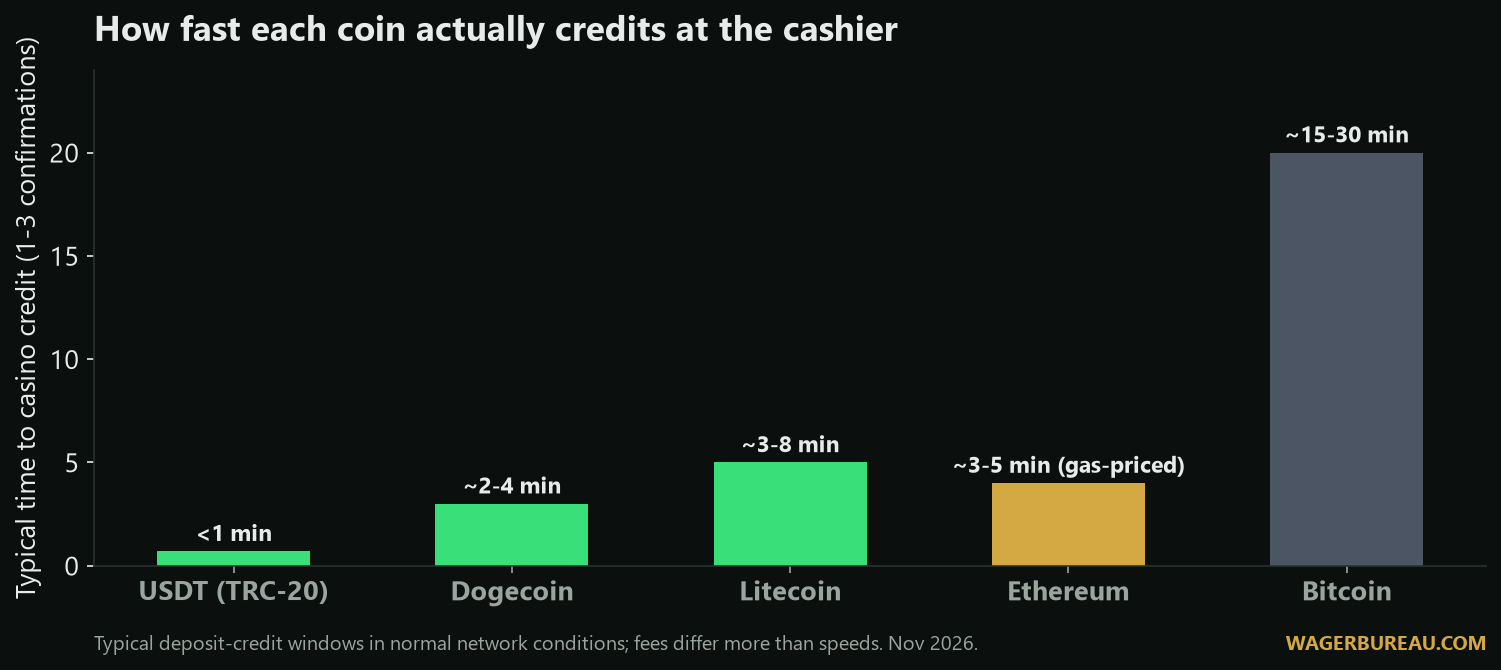
Timing is the part ETH does well. Post-merge Ethereum produces blocks every twelve seconds with fast finality characteristics, and casino cashiers typically credit ETH deposits in a few minutes, comfortably quicker than Bitcoin's confirmation march. Speed was never Ethereum's problem for this use case; price-per-move was, and both deserve to be said in the same sentence.
The sizing rule
ETH is a mid-to-large-transfer rail: gas is noise on four figures and a tax on small deposits. Under a couple hundred dollars per move, LTC does the same job for cents; for fiat-stable value, USDT on TRC-20.
SECTION 02
The mainnet truth: why your cheap L2 ETH does not help here
The standard 2026 answer to Ethereum fees is layer-2 networks, where transfers cost cents. The casino segment has not followed: cashiers in our set, and across the industry's mainstream, issue mainnet deposit addresses and broadcast mainnet withdrawals. Funds sitting on an L2 must bridge back to mainnet before a casino can receive them, and that bridge hop costs mainnet gas plus time, erasing the savings for this specific use.
The operational warning is the same class as the USDT network rule, and it loses real money every week somewhere: send only mainnet ETH to a casino deposit address, and never direct an exchange withdrawal on an L2 network at a cashier address. Where a cashier explicitly lists additional networks, match exactly what it lists; where it does not, mainnet is the assumption. The deposits guide covers the address-verification habit, and a test transaction before any first large move remains the cheapest insurance in crypto.
Why have casinos stayed mainnet-only? Custody tooling, batch-processing infrastructure and the long tail of player wallets all standardize there, and operators optimize for the rail every player can use over the rail some players would prefer. The practical reading for you: treat Ethereum-at-casinos as mainnet Ethereum, price it accordingly, and let the three-way table below pick the rail per transaction rather than per identity.
| You are moving | Best rail | Why |
|---|---|---|
| ETH you already hold, mid-to-large size | ETH mainnet | Gas is noise at size; minutes-level crediting |
| Small or frequent moves | Litecoin | Cents in fees, ~2.5-minute blocks, universal support |
| A bankroll you think about in dollars | USDT on TRC-20 | Stable unit, near-instant settlement, cents in fees |
| Funds currently on an Ethereum L2 | Bridge first, then decide | Casinos receive on mainnet; bridging costs gas either way |
Rail per transaction, not per loyalty: all four options are supported across the audited six.
SECTION 03
Cashouts, bonuses and support at the six
Withdrawals follow the two-clock model from the Payout Speed Index: the measured processing window, ten minutes typical at mBit, twelve at Winz.io, fourteen median at Oshi, under an hour at LevelUp, inside a day at Lucky Dreams and JustCasino, plus Ethereum's minutes-level chain leg once broadcast. End-to-end at the fast brands, an ETH cashout is spendable in roughly a quarter of an hour, with the gas bill as the toll both ways.
Bonuses treat ETH like every volatile coin: fiat-denominated packages track the deposit at credit-time value, wagering arithmetic from the bonus hub applies unchanged, and the price-move interaction with fiat-tracked requirements is live for the whole clearing window, the argument the stablecoin page makes at length. Winz.io's 1x crypto deposit turnover versus 3x fiat favors ETH exactly as it favors every coin rail.
Support needs one line: all six audited brands take ETH for deposits and withdrawals, with per-coin minimums in the terms, and several list additional ERC-20 assets whose gas costs make the TRC-20 comparison worth re-reading before using them. Coin support, once again, does not differentiate the six; the five-pillar scores do.
SECTION 04
The verdict: a strong rail with one honest precondition
Ethereum earns its place in the casino core for the players it fits: those already holding ETH, moving meaningful size, who want minutes-level settlement on the most liquid smart-contract asset there is. For them the premium is small, the speed is real, and nothing on this page argues against the habit. The precondition is only that it is a decision: sized transfers, mainnet discipline, gas checked in the wallet before sending rather than discovered after.
Picks through the ETH lens repeat the board, because the rail rides the same cashiers everywhere: mBit at 8.7 for the fastest processing, Winz.io at 9.2 for the economics, Oshi at 9.4 for the strongest overall audited profile. And for the player who arrived here holding nothing yet, the honest close is the cross-link: read the USDT playbook first, because the best Ethereum strategy for a fiat-thinking gambler is usually Tether riding a cheaper chain.
ETH at the six, one line
Accepted at all six; mainnet only; minutes-level crediting; gas makes it a mid-to-large-transfer rail. Fastest end-to-end: mBit. If you think in dollars, the stablecoin page is the better starting point.
FAQ
Frequently asked
Which casinos accept Ethereum?+
Why are Ethereum casino fees so high?+
Can I deposit to a casino from an Ethereum L2?+
How fast are Ethereum casino withdrawals?+
FOOTNOTE
This article is original editorial published by Wager Bureau on 2026-11-08. Every claim in the article is independently verifiable against the cited sources. We update articles when material facts change and surface the "updated" date at the top of the page. 18+ · gambling can be addictive · please play responsibly. If gambling stops being fun, call GamCare or the NCPG. See the bureau's full responsible gambling page for free 24/7 helplines. Key terms used on this page are defined in the glossary.