
USDT Casinos (2026): The Stable-Bankroll Playbook
Tether at crypto casinos done properly: why a USDT bankroll removes the coin-volatility layer, the TRC-20 versus ERC-20 fee decision that changes everything, how stablecoins interact with bonuses and wagering, which audited brands support USDT (all six), and the measured cashout timing.
9 min read · published 2026-11-08
USDT is the quiet professional of casino banking: no price story, no community, nothing to cheer for, which is precisely its value. A Tether balance is a dollar balance that settles like crypto, and that single property removes the entire second layer of risk every volatile coin adds to gambling, the one where your bankroll moves overnight without a single bet placed. The bureau's standing position across the pillar guide and the bankroll chapter is that players who think in fiat should play in stablecoins, and this page is that position turned into a complete playbook: the volatility arithmetic, the network choice between TRC-20 and ERC-20 that decides whether transfers cost cents or dollars, the specific advantage stablecoins hold in bonus wagering, the support map across the audited six, and the measured timing from the Payout Speed Index applied to the Tether rail.
IN THIS ARTICLE
SECTION 01
The volatility argument, with honest numbers
A gambling bankroll already carries variance by design; a volatile-coin bankroll carries two. Hold a Bitcoin balance through an ordinary ten percent weekly move and your bankroll changed ten percent with zero spins, in either direction, on top of whatever the games did. Session discipline, stop-losses and unit sizing, the entire apparatus from the bankroll chapter, gets measured in fiat terms while the measuring stick itself moves underneath it. USDT pins the stick: a $500 bankroll is $500 tomorrow, and every win, loss and limit means exactly what it says.
The honest counter-case exists and deserves its sentence: if you are deliberately long crypto and gambling with coins you intend to hold anyway, denominating in BTC is a coherent choice, covered in the Bitcoin Canada guide along with the capital-gains footnote that comes with it. The mistake is not holding coins; the mistake is holding a volatile coin accidentally, as a side effect of never choosing. Most players never chose. This page is the choice.
One structural note on what USDT is: a centrally issued stablecoin whose peg depends on its issuer, not a trustless asset. For the hours-to-days horizons of a casino balance that distinction has not mattered in practice, and the keep-the-float-small rule from the security chapter bounds the exposure anyway: money at rest belongs in your own wallet, in whatever asset you actually want to hold.
Who should play in USDT
Anyone who thinks in dollars: bankroll, limits and results all mean what they say, with crypto settlement speed intact. Deliberate coin-holders are the exception; accidental coin-holders are the audience.
SECTION 02
TRC-20 versus ERC-20: the fee decision that dwarfs everything
USDT exists on multiple networks, and the network choice at the deposit screen matters more than every other fee decision combined. Tether on Ethereum (ERC-20) pays Ethereum gas: variable, congestion-priced, routinely dollars per transfer and occasionally much worse. Tether on Tron (TRC-20) transfers for cents with seconds-level settlement, which is why the TRC-20 rail carries the overwhelming share of casino stablecoin volume, and why every cashier in our set that lists USDT lists the Tron variant.
The operational rule is absolute: the network you withdraw to must match the network of the address you paste. A TRC-20 withdrawal sent to an ERC-20 address, or the reverse, is the classic self-inflicted loss of the stablecoin world, and no support desk reliably recovers it. Every wallet from the deposits guide labels its networks; thirty seconds of matching beats any fee optimization ever invented. Where a brand offers USDT on additional networks, the same matching rule covers them.
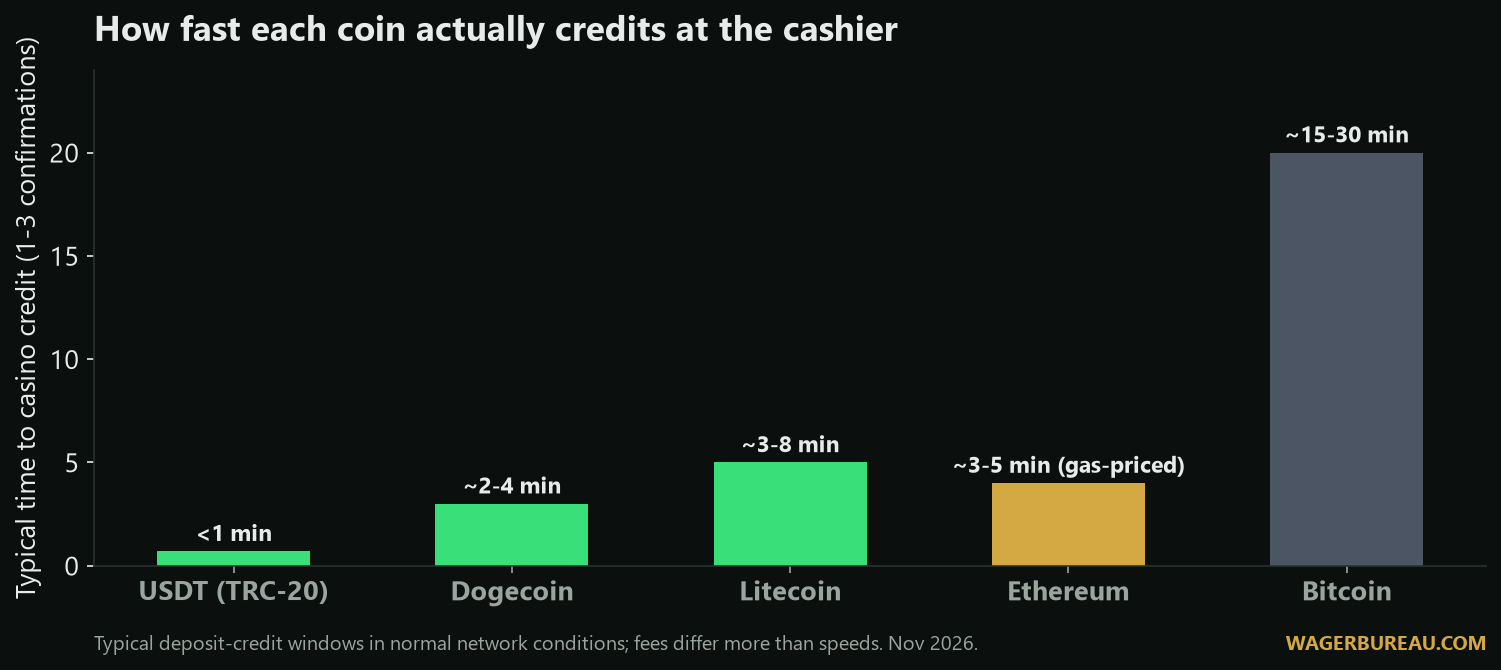
Speed stacks in Tether's favor on the final leg: TRC-20 settlement is effectively near-instant once broadcast, so the measured processing windows are the whole wait. mBit's ten-minute typical processing is ten minutes to spendable dollars; Winz.io's twelve is twelve. No other rail in the segment turns the operator's clock into the entire end-to-end time quite so cleanly.
| Rail | Typical network fee | Settlement after broadcast | Use it when |
|---|---|---|---|
| USDT TRC-20 (Tron) | Cents | Seconds to ~1 minute | Default for deposits and cashouts |
| USDT ERC-20 (Ethereum) | Dollars, congestion-priced | Minutes | Only if your funds already live on Ethereum |
| Bitcoin | Varies with mempool | ~10 min first confirmation | BTC-denominated bonuses, deliberate holding |
| Litecoin | Cents | ~2.5 min first confirmation | Small moves when you want a volatile coin anyway |
Always match the withdrawal network to the receiving address network; cross-network sends are typically unrecoverable.
SECTION 03
Stablecoins and bonuses: the quiet edge
Bonus wagering is denominated in fiat terms, and that creates the interaction documented across the bonus hub: clear a fiat-tracked requirement while your coin's price moves and the requirement's cost in coin terms moves with it. A USDT bankroll deletes the interaction. Forty-x of a $500 bonus is $20,000 of turnover, and with a stable unit it stays $20,000 in the only terms that matter, letting you price an offer before opting in and have the price hold.
The same stability cleans up every other number on the site. Max-bet rules bind in fiat; stop-losses from the bankroll framework are set in fiat; Winz.io's 1x-crypto deposit turnover is computed on value. Playing in USDT means every one of those thresholds is a fixed line rather than a moving one, which is a small cognitive subsidy per session and a large one per month. The wager-free exception stays what it always was: wheel prizes at Winz.io pay withdrawable value at 0x regardless of rail, as the zero-wagering guide covers.
Support across the set is universal: all six audited brands take USDT, alongside the BTC, ETH, LTC and DOGE core, with USDC also widely listed for players who prefer the alternative issuer. Minimums sit in the usual bands, deposits credit on network confirmation, and the fine print is the same per-coin withdrawal minimums noted on every rail page. Nothing about the stablecoin lane is exotic, and that is its entire pitch.
SECTION 04
The playbook and the picks
The complete USDT routine fits in a paragraph. Acquire on a regulated exchange, every platform in the Canadian pipeline lists USDT, withdraw to your own wallet on TRC-20, deposit to the casino on TRC-20, play with fiat-meaning numbers, withdraw winnings promptly to the same saved address, and hold value between sessions in whatever asset you actually chose to hold. Every speed figure from the Payout Speed Index applies, minus almost all chain time.
Picks through the stablecoin lens: Winz.io at 9.2 pairs the stable bankroll with the segment's only wager-free welcome and twelve-minute processing, the cleanest combination in the set for a fiat-thinking player. mBit at 8.7 is the speed ceiling at ten minutes to settled dollars. Oshi at 9.4 remains the strongest overall profile with no-KYC-by-default operation. The board, the negatives included, is in the reviews; the coin decision, as always, never has to compromise the brand decision.
USDT at the six, one line
Accepted at all six, TRC-20 the default rail. Fastest settled dollars: mBit ~10 min. Best paired economics: Winz.io 0x wheel. Match networks on every withdrawal, every time.
FAQ
Frequently asked
Which casinos accept USDT?+
Is USDT better than Bitcoin for gambling?+
Should I use TRC-20 or ERC-20 for casino USDT?+
How fast are USDT casino withdrawals?+
FOOTNOTE
This article is original editorial published by Wager Bureau on 2026-11-08. Every claim in the article is independently verifiable against the cited sources. We update articles when material facts change and surface the "updated" date at the top of the page. 18+ · gambling can be addictive · please play responsibly. If gambling stops being fun, call GamCare or the NCPG. See the bureau's full responsible gambling page for free 24/7 helplines. Key terms used on this page are defined in the glossary.