
Stake Casino Review (2026): The Desk Audit
An honest desk audit of Stake.com, the biggest name in crypto gambling: the Medium Rare N.V. operator and reported Curaçao OGL license examined, the conditional-licensing questions raised by leaked regulator records, the rakeback-and-VIP economics, the US split with Stake.us, and measured alternatives.
10 min read · published 2026-11-08
Stake.com is the reference point of crypto gambling: launched in 2017 by the founders behind 2013's Primedice, grown into the segment's dominant brand on originals, streaming culture and some of the most visible sponsorship deals in sport. None of that is a safety rating, and the bureau's rule does not bend for size: Stake is not one of the six brands we account-test monthly, we earn nothing from it, and this page carries no code and no score. It carries the audit checklist instead: the operator and license as the public record and investigative reporting describe them, the economics of a rakeback-and-VIP model with no classic welcome, the geographic split that sends Americans to a different product entirely, the unknowns stated as unknowns, and the routing to brands with measured numbers. Siblings in the series: Bitz.io, Roobet, Rainbet; method: the pillar guide.
IN THIS ARTICLE
SECTION 01
Operator, vintage and the license question
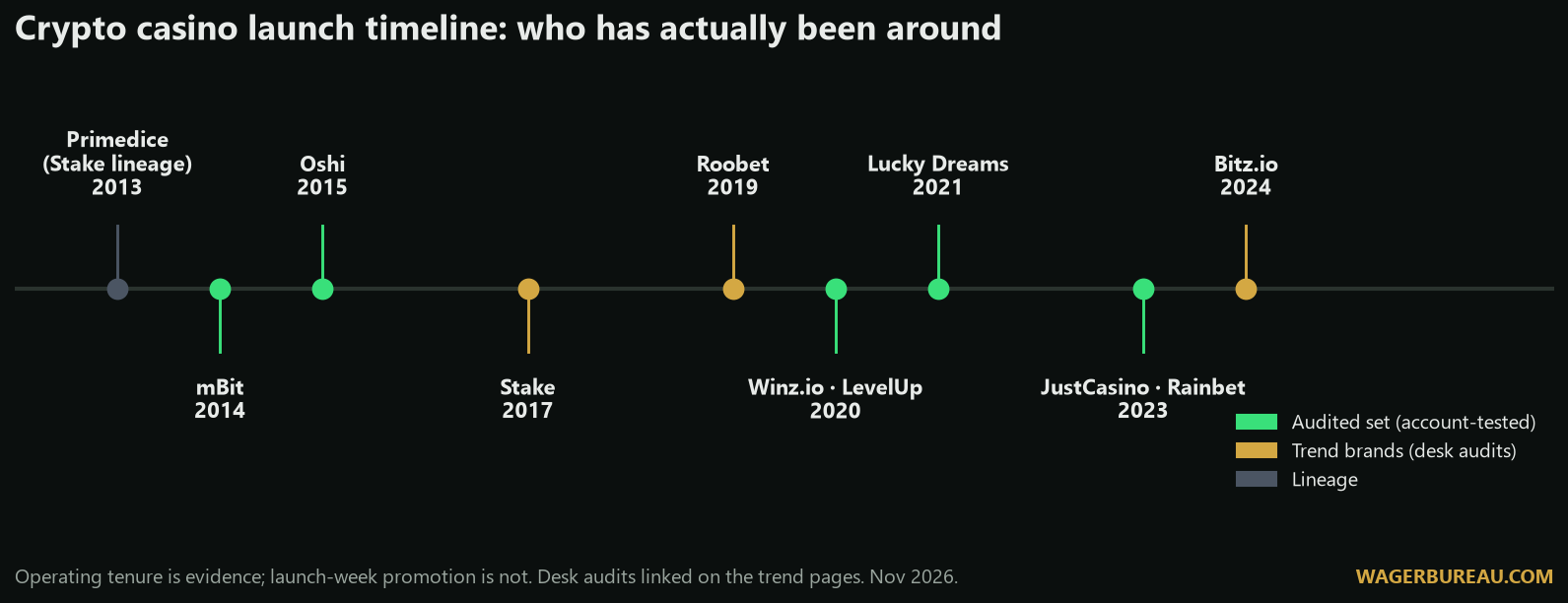
The corporate facts are unusually well documented for the segment. Stake is operated by Medium Rare N.V., incorporated in 2017 when stake.com launched, founded by Ed Craven and Bijan Tehrani, whose lineage runs through Primedice, the 2013 provably fair dice site that effectively prototyped the crypto-originals category. Nine years of continuous operation is the longest track record in the trend-brand series by a distance, and operating tenure is a pillar this site weighs heavily.
Licensing is where 2026 reporting earns a careful paragraph. Stake's Curaçao license is reported under the post-LOK framework with number OGL/2024/1451/0918, granted in mid-2025, and OGL-class licenses are normally verifiable in the public register at gamingcontrolcuracao.org. However, reporting by Gambling Insider based on leaked Curaçao regulator records stated that the license was granted conditionally, with the regulator requiring Medium Rare to clarify its ownership structure and related-company relationships within a set deadline, and that reporting could not confirm whether those conditions were ultimately satisfied. The bureau takes no position beyond the sourcing: a numbered, registrable license exists per the record; credible trade press has raised unresolved questions about the conditions attached to it. Both facts belong in the summary, and the licensing guide explains why conditional grants matter.
Geography splits the product in two. Stake.com restricts the United States along with a list of regulated European markets where it holds no local license, per public reviews France, Spain, Germany and Italy among them, and routes US traffic to Stake.us, a legally distinct sweepstakes-model product with different mechanics, currencies and rules. A player searching 'Stake review' from the US is researching a different product than this page describes, and conflating the two is the single most common error in coverage of the brand.
The verifiable core
Operator: Medium Rare N.V., founded 2017 (Craven / Tehrani, ex-Primedice 2013). License: Curaçao OGL/2024/1451/0918 reported mid-2025; trade press (leaked regulator records) reported it as conditionally granted with ownership-disclosure conditions, resolution unconfirmed. US excluded: Stake.us is a separate sweepstakes product. Check the register and the live terms yourself.
SECTION 02
The economics: rakeback, VIP and no classic welcome
Stake popularized the model the trend wave now imitates: no headline deposit match, with value routed through a levelled VIP ladder, rakeback-style rebates, reload drops and an aggressive promotional calendar of races and raffles. The architecture, as the cashback guide argues, is structurally more honest than 40x welcome treadmills: it pays in proportion to actual play and skips the max-bet-and-validity trap entirely.
The desk-audit caveat is the same one the whole model carries: effective rates are tier-dependent, negotiated upward at VIP levels, and not published as a simple standing schedule a prospective player can price from the outside. That is an information asymmetry, mild at Stake compared to referral-code-only brands like Rainbet, because the level system itself is documented in-product, but an asymmetry nonetheless. The published, boring versions of the same architecture inside our audited set remain JustCasino's 10% Tuesday cashback and LevelUp's VIP ladder, with Winz.io running the wager-free variant.
On games, Stake's originals are the genre-defining provably fair catalog, dice, crash, plinko, mines and limbo descending directly from the Primedice lineage, alongside a licensed-studio lobby of thousands of titles. The verification mechanics are exactly the commit-reveal scheme in our provably fair guide, and Stake implements them with published seeds and formulas. On that specific axis the brand's credentials are genuine and historically foundational; fairness-of-execution, as that guide stresses, says nothing about payout behavior or terms conduct, which are separate pillars.
The model, priced honestly
No welcome match; levelled VIP + rakeback instead. Architecture: player-friendlier than wagered headlines. Transparency: tier-dependent rates, not a published standing schedule. Provably fair originals: genre-defining and genuinely verifiable. Published equivalents exist in the audited set.
SECTION 03
Flags and unknowns, stated plainly
The flags a fair summary carries. First, the conditional-license reporting above: unresolved in the public record, material if the regulator's conditions were missed, and exactly the kind of fact a review funded by Stake commissions would omit, which most ranking pages for this query are. Second, the regulated-market absences: no local licenses in major European regulated markets means players there are outside both the operator's permission and their own market's protections, a worse position than either alone. Third, scale itself: Stake's size makes it the segment's biggest magnet for both legitimate complaints and noise, and reading its dispute-platform record requires separating volume from rate, which casual star-averages do not.
The unknowns: measured payout windows, no public measurement series exists of the kind this site runs, and anecdote at Stake's volume is statistically worthless in both directions; effective VIP economics at any given level; and the terms-conduct record under stress, which only account-testing and complaint-thread archaeology establish. Nine years of operation is real evidence of operational competence; it is not a substitute for the three pillars above, and the bureau scores nothing it has not measured.
If you play at Stake, the routine is unchanged from every audit in this series, scaled to the brand's one genuine structural difference: there is no welcome-bonus trap to avoid, so the routine is purely operational. Small first deposit, one complete deposit-to-withdrawal loop before meaningful bankroll, winnings moved to your own wallet promptly, and the restricted-territories clause read against your actual jurisdiction, because the US-and-regulated-Europe split catches more players at Stake than anywhere else in the segment.
SECTION 04
Stake against the audited six
On tenure, Stake's 2017 start trails only mBit's 2014 across every brand this site covers, and comfortably leads the rest of the trend series. On license class, its reported Curaçao OGL sits in the same register as mBit and JustCasino / Lucky Dreams, with the conditional-grant reporting as the asterisk none of our six carries. On rewards architecture, its rakeback-VIP model is the category standard the audited set matches with published schedules. On provably fair depth, its originals catalog is the genre reference, with mBit's sixteen in-house titles the deepest equivalent among brands we actually test.
On the deciding pillar, measured payouts, the audited board stands as always: mBit ~10 minutes, Winz.io ~12, Oshi 14 median, timed numbers against a giant's unmeasured promises. The honest bottom line mirrors the whole series: Stake is the segment's most established operator with the segment's most visible unresolved regulatory question attached, and neither fame nor flags substitute for measurement. When the account-testing queue reaches it, the desk audit becomes a score; until then, players who want Stake's model with published terms have the board, and players who want Stake have, at minimum, this page's checklist.
Desk audit verdict
Longest tenure in the trend series (2017), genre-defining provably fair originals, rakeback-VIP economics with tier-opacity, reported Curaçao OGL license with credible trade-press questions about conditional grant and ownership disclosure, US routed to a separate sweepstakes product. Unscored because unmeasured. Measured speed lives at mBit, Winz.io, Oshi.
FAQ
Frequently asked
Is Stake casino legit?+
Does Stake have a welcome bonus?+
Can I play Stake from the US?+
What license does Stake have?+
What are the best Stake alternatives?+
FOOTNOTE
This article is original editorial published by Wager Bureau on 2026-11-08. Every claim in the article is independently verifiable against the cited sources. We update articles when material facts change and surface the "updated" date at the top of the page. 18+ · gambling can be addictive · please play responsibly. If gambling stops being fun, call GamCare or the NCPG. See the bureau's full responsible gambling page for free 24/7 helplines. Key terms used on this page are defined in the glossary.