
Provably Fair Casinos: How the Cryptography Works and What It Proves
Provably fair gambling explained properly: the commit-reveal scheme with server seeds, client seeds and nonces, a step-by-step verification walkthrough, what provable fairness guarantees versus what RNG certification covers, its hard limits, and which audited brands support it deepest.
11 min read · published 2026-11-08
Provably fair is the crypto-native answer to the oldest question in gambling: how do I know the game was not rigged against me on this specific round? Traditional casinos answer with institutional trust, a certificate from a testing lab saying the random number generator behaved during an audit. Provably fair answers with cryptography: the operator mathematically commits to the round's randomness before you bet, you contribute entropy of your own, and after the round you can verify, independently and permanently, that the result was never altered. It is a genuinely stronger guarantee, it applies to a specific class of games, and it is routinely both oversold and underused. This guide explains the mechanism without hand-waving, walks a real verification, draws the line between provable fairness and RNG certification, states the limits plainly, and maps support across the audited six. Context for the whole product class lives in the crypto casino pillar.
IN THIS ARTICLE
SECTION 01
The commit-reveal mechanism, explained properly
Every provably fair round is built from three inputs. The server seed, a long random string generated by the casino, which determines outcomes; the client seed, a string you control and can change, which enters the computation alongside it; and the nonce, a counter incrementing with each bet under the same seed pair. The game result is a deterministic function, typically HMAC-SHA256, of those three values: same inputs, same outcome, forever.
The trick that makes it trustless is the order of operations. Before you place any bet, the casino shows you the hash of the server seed, a cryptographic fingerprint computed with SHA-256. A hash is one-way: the casino cannot find a different seed that produces the same fingerprint, so publishing the hash locks the seed in place, mathematically, while keeping it secret. You then set or accept a client seed the operator could not have predicted. Your bets play out. When you rotate seeds, the casino reveals the old server seed in full, and you can check two things: that it hashes to the fingerprint you were shown before betting, and that seed plus your client seed plus each nonce reproduces exactly the results you got.
If both checks pass, the operator provably could not have altered outcomes after seeing your bets: the randomness was committed before play, your entropy entered after the commitment, and the result function is public. That is a per-round, player-verifiable guarantee no audit certificate can match, and it requires trusting no lab, no regulator and no reputation, only SHA-256, the same primitive securing Bitcoin itself, as covered in the security chapter of the pillar.
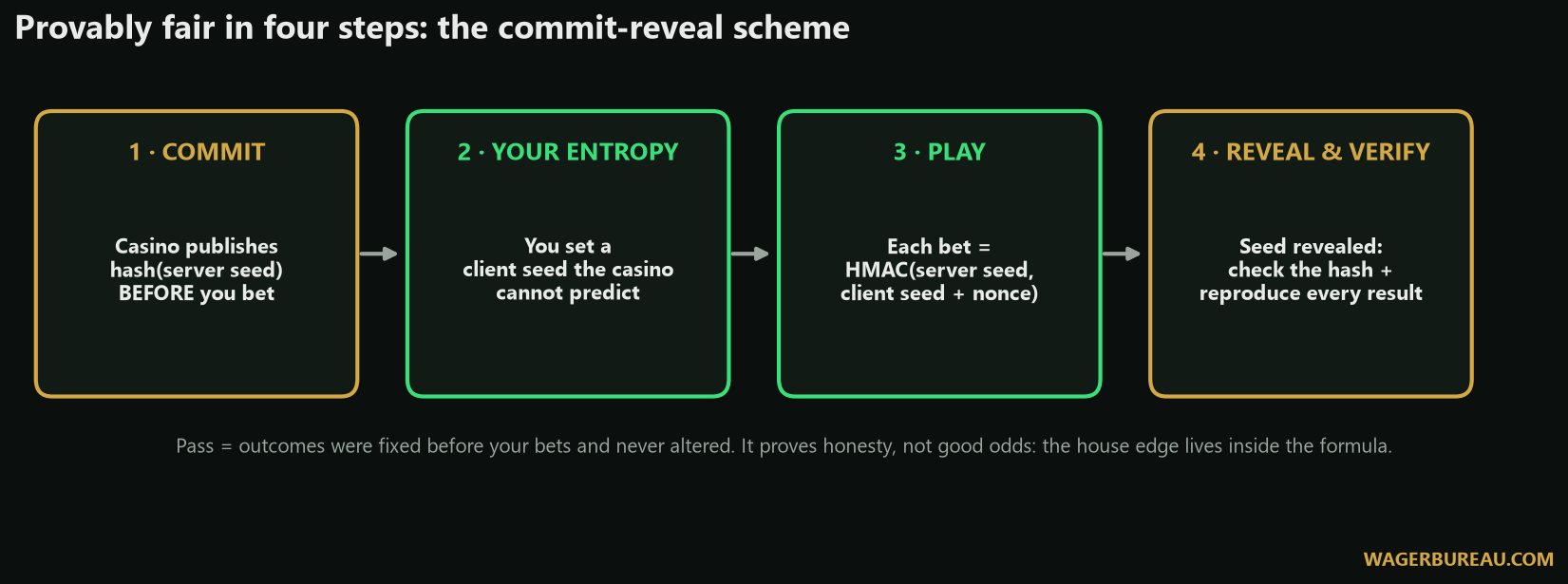
The scheme in four lines
1) Casino publishes hash(server seed) before you bet. 2) You supply a client seed. 3) Results = HMAC(server seed, client seed + nonce). 4) On rotation, the seed is revealed: check it matches the hash and reproduces your results. Pass = the round was not rigged.
SECTION 02
Verifying a round yourself: the walkthrough
The procedure takes five minutes the first time and is worth doing once on principle, the way verifying a license in the registry is. First, before playing, open the game's fairness panel, note the hashed server seed, and set your own client seed to any string you like; changing it from the default proves the entropy was yours. Second, play your session normally while the nonce counts your bets. Third, rotate your seed pair in the fairness panel, which forces the casino to reveal the retired server seed.
- Copy the revealed server seed into any SHA-256 calculator (an offline one if you want zero trust) and confirm the output equals the hash shown before you played.
- Open the game's published result formula, every provably fair title documents one, and feed it the revealed seed, your client seed, and a bet's nonce.
- Confirm the computed outcome matches the result you actually received for that bet; spot-check a winning and a losing round.
- If anything fails to match, screenshot everything, export the seed data, and escalate: first to support, then to the license complaint channel. A genuine mismatch is a five-alarm finding.
What a pass means
A matching hash plus reproduced results proves outcomes were fixed before your bets and never altered after. It does not prove the odds were good, only that the stated game was the game you actually played.
SECTION 03
Provably fair versus RNG certification
Standard slots from licensed studios, the Pragmatic Play and NetEnt catalogs filling every lobby, are not provably fair. Their integrity model is RNG certification: a testing laboratory, iTech Labs and eCOGRA are the segment staples, audits the random number generator and the game's return-to-player configuration, and the license requires the certificate. That model audits the generator, periodically and institutionally; provable fairness verifies the round, individually and mathematically. One asks you to trust a lab's sample; the other hands you the proof for your own bets.
The honest comparison cuts both ways. Provable fairness covers only games built for it, the crypto-native originals: dice, crash, plinko, mines, limbo and their relatives, where the operator controls the result function and can expose it. Studio slots cannot retrofit the scheme because their math models are proprietary and their rounds resolve on the studio's servers. So a real casino's integrity stack is layered: provably fair originals verified by you, certified studio games vouched by labs, and the license, checked at the registry, binding the operator to both. A lobby advertising provable fairness while hiding its license has the stack upside down.
Where this runs deepest in our set: mBit's sixteen in-house original titles form the largest native provably fair catalog we track, with Oshi's Bitcoin-exclusive originals close behind; every brand in the six supports verification on its originals. Depth of the native catalog is a genuine differentiator for players who want the verifiable layer to be more than a checkbox, and the reviews score it inside the games pillar.
SECTION 04
The limits: what provably fair does not do
Provable fairness proves the game was played straight; it does not make the game good. The house edge is written into the result function itself, a provably fair dice game at a 1% edge will provably, fairly, grind down your bankroll at exactly that rate, and verification confirms the grind was honest. No cryptography changes expected value, and any pitch using 'provably fair' to imply 'beatable' is lying with mathematics. The RTP and variance guide covers the numbers that actually decide cost.
Three further boundaries complete the honest picture. The scheme does not cover payouts: an operator can run flawless commit-reveal and still stall withdrawals, which is why measured payout behavior is a separate audit pillar. It does not cover studio games, as above, which are most of every catalog. And it is only as good as its implementation: a fairness panel that never reveals seeds, undocumented result formulas, or seeds that rotate without your action are implementation smells worth treating as failures. The feature earns trust when it is checkable; the point of this guide is that you now can.
Three things it never proves
That the odds are favorable (the edge is in the formula). That withdrawals will pay (separate pillar, measured separately). That studio slots are fair (that is RNG certification's job). Provably fair = honest execution of a game that still has a house edge.
FAQ
Frequently asked
What does provably fair mean?+
How do I verify a provably fair game?+
Are provably fair games better than regular slots?+
Can a provably fair casino still cheat?+
Which casinos have the best provably fair games?+
FOOTNOTE
This article is original editorial published by Wager Bureau on 2026-11-08. Every claim in the article is independently verifiable against the cited sources. We update articles when material facts change and surface the "updated" date at the top of the page. 18+ · gambling can be addictive · please play responsibly. If gambling stops being fun, call GamCare or the NCPG. See the bureau's full responsible gambling page for free 24/7 helplines. Key terms used on this page are defined in the glossary.